
Recently, ManpowerGroup released the "2016 Fourth Quarter Employment Outlook Survey in Mainland China". The survey found that employers' recruitment trends have picked up in the coming quarter, breaking away from the current tight employment situation. Employers in Shenzhen are expected to have the strongest recruitment intentions among the nine major regions or cities, and employers in the service industry have the most optimistic recruitment plans.
ManpowerGroup classified the mainland into 5 cities (North China, Shanghai, Guangzhou, Shenzhen and Chengdu) and 4 regions (North China, East China, South China, Central China and West China). The employment prospects survey sampled 4,337 employers in the region to understand the company's intention to increase or decrease employees in the next October to December. The results show that the net employment outlook index for the fourth quarter in mainland China is +5%. 7% of Chinese employers expect to increase the number of employees, only 2% of employers expect to reduce the workforce, and 52% of employers say there will be no change in the number of employees this year.
The service industry maintains the best employment situation throughout the year
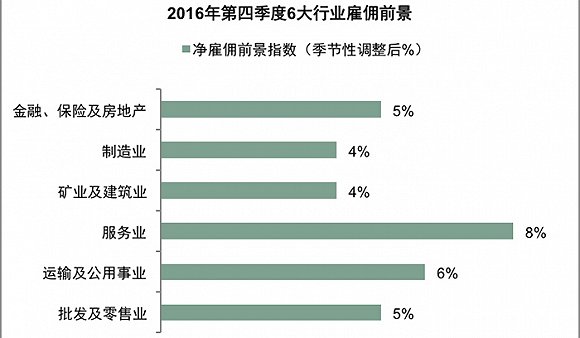
The survey calculates the Net Employment Outlook by subtracting the share of employers expecting to reduce headcount from the share of employers who expect to increase headcount in the next quarter. The employment prospects index of the service industry in the fourth quarter was 8%, an increase of 4 percentage points from the previous quarter, continuing to maintain its leading position among the six major industries. Looking at ManpowerGroup's full-year employment demand forecast for 2016, the service industry's employment outlook index was 10% in the first quarter, 6% in the second quarter, and 4% in the third quarter, maintaining the strongest labor demand throughout the year.
According to China's National Bureau of Statistics, the service industry currently accounts for 50.5% of the country's GDP. Zhang Jinrong, Vice President of ManpowerGroup Greater China, believes: "With the rapid development of the mobile Internet economy and the upgrading of the information industry, new driving forces for economic growth are being nurtured. The emergence of new business formats and business models, as well as new products, will stimulate the development of e-commerce, logistics express delivery, information consumption and other service fields." At the same time, the upgrade and application of new generation information technologies such as the Internet of Things, cloud computing, big data, and artificial intelligence will create new job demands. ”The potential of the service industry to absorb employment will continue to increase in the future.
The weakest hiring expectations for the fourth quarter are among employers in the manufacturing and mining and construction industries, with an employment outlook index of 4%. Employer expectations in the mining and construction industry increased by 2 percentage points from the previous quarter, but fell by 3 percentage points from the same period last year. In the policy environment of cutting overcapacity and adjusting structure, industries such as steel, coal and petroleum have already seen downsizing. Zhang Jinrong estimates that millions of people in the steel and coal industries alone will need to change jobs. Future employment prospects in industries such as manufacturing, mining and construction are also expected to grow slowly.
Theoretically, it is easiest to change jobs in Shenzhen
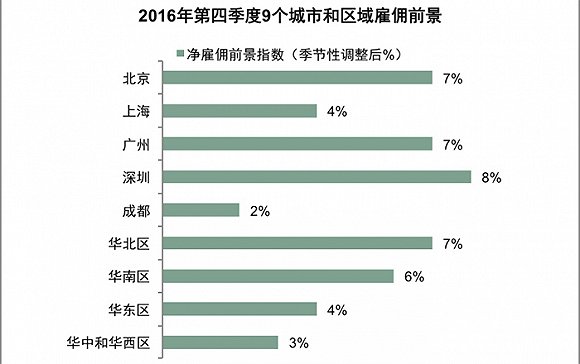
The survey shows that in the next quarter, 8 out of 9 regions and cities have restored strong employment prospects. The North China Net Employment Outlook Index increased by 6 percentage points. The net employment outlook index for Southern China increased by 4 percentage points. At the same time, employment prospects in Central and Western China remain relatively stable.
In the last quarter of 2016, Shenzhen had more employers looking to add employees than other regions and cities, reaching 8%. In the previous three quarters, Shenzhen's employment prospect index was 8%, 7% and 2% respectively, ranking second in each. The regional government encourages the development of high-tech industries, international trade and other outsourcing services. Tencent, Huawei, Foxconn and other high-tech design and manufacturing industries are gathered here, which has strong labor digestion capacity. In the next three months, more employers will start recruitment plans.
In addition, Beijing's employment competition pressure has also eased, with the net employment outlook index at 7%. Most employers in Chengdu do not plan to recruit new employees in the future. Chengdu’s net employment outlook index for the fourth quarter was 2%, which was the same as the previous quarter and the same period last year.
Look for jobs in large and medium-sized companies
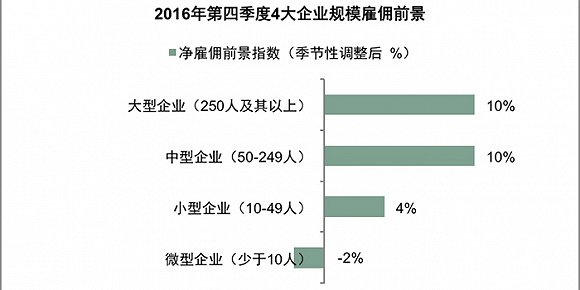
ManpowerGroup divided the interviewed companies into four types according to size: micro-enterprises with less than 10 employees; small enterprises with 10-49 employees; medium-sized enterprises with 50-249 employees; and large enterprises with 250 or more employees. Employer expectations at large and medium-sized companies are the strongest, with net employment outlook indexes both at 10%. Small business employer expectations are moderate, with a net hiring outlook of 4%. Employer expectations for micro businesses are the weakest, with a Net Employment Outlook of -2%.
“In the first half of 2016, all types of overseas M&A activities increased and reached a new high. The number of transactions was 29% higher than that of the whole of 2015. We expect this trend to continue. "Zhang Jinrong said, "These investors are mainly large enterprises, and these actions are bound to drive their demand for talents. ”