
On September 6, local time, the British higher education consultancy Quacquarelli Symonds (QS) released the "QS 2016-2017 World University Rankings" on TopUniversities.com. QS was founded in 1990. It initially cooperated with the Times Higher Education Supplement to jointly publish the "Times Higher Education-QS World University Rankings" from 2004 to 2009. Later, QS independently published its own rankings. Bill Kirby, professor of Chinese history at Harvard University, believes that the QS ranking, along with the Shanghai Jiao Tong University ranking (ARWU) and the London Times ranking, are the most influential and authoritative rankings in the world.
For this ranking, QS examined more than 3,800 universities around the world. In the end, 916 universities were on the list and 400 universities were independently ranked. QS evaluates each university based on six indicators, four of which are based on "hard" data and the remaining two indicators are based on global surveys. These six indicators are academic reputation (40%), employer evaluation (10%), student-teacher ratio (20%), faculty citations of academic achievements (20%), international faculty ratio (5%), and international student ratio (5%).
MIT, Stanford University and Harvard University occupy the top three spots in this ranking; among the top 20 rankings, American universities occupy 11 seats; a total of 154 American universities are on the list, reflecting the leading position of American universities in global higher education.
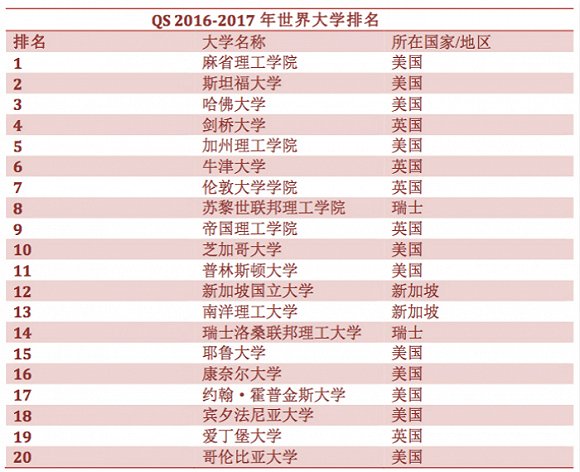
A total of 238 universities in Asia are on the list. The two top universities are both from Singapore, namely the National University of Singapore (12th) and Nanyang Technological University (13th). The three highest-ranked universities in Japan are the University of Tokyo (34th), Kyoto University (37th) and Tokyo Institute of Technology (56th). The three highest-ranked universities in South Korea are Seoul National University (35th), Korea Advanced Institute of Science and Technology (46th), and Pohang Institute of Technology (83rd). The three highest-ranked universities in Hong Kong are the University of Hong Kong (27th), the Hong Kong University of Science and Technology (36th) and the Chinese University of Hong Kong (44th).
A total of 33 universities in mainland China are on the list, among which the top 50 are Tsinghua University (24th), Peking University (39th) and Fudan University (43rd). Other top-ranked universities include Shanghai Jiao Tong University (61st), University of Science and Technology of China (104th), Zhejiang University (110th) and Nanjing University (115th).
Although the academic status of American universities is still unshakable at present, Ke Weilin believes that Chinese universities and European universities are struggling to catch up. In an interview with Harvard Business School, he said that if the policy continues to invest resources in mainland China universities, one or two mainland China universities will enter the top 20 in the short term. Within 10 to 15 years, mainland China universities will enter the top 20 of most university lists, and two will enter the top 10.