From "subway", "high-speed rail" to "hospital", in recent years science fiction writer Han Song has described the most bizarre and dark spaces in the city. Writer Alai called Han Song's writing style "weird and gorgeous", and science fiction writer Fei Deuterium also commented that what he wrote was "ghostly China". In an exclusive interview with Jiemian Culture, Han Song said, "The world described by Zhao Shuli and Wang Zengqi has long since disappeared. The world I wrote is just like reality. It's not that I want it to be weird, nor does it look like Kafka or Borges. I just conform to reality."
The inspiration for this new work "Hospital" also comes from the real-life medical experience of himself, his family, and friends. Han Song realized that "Hospitals are different from high-speed trains and subway high-speed movements. They are always slow, stagnant, and even like death. However, people can always feel the confusion of life and death, and the mixture of sorrow and joy."
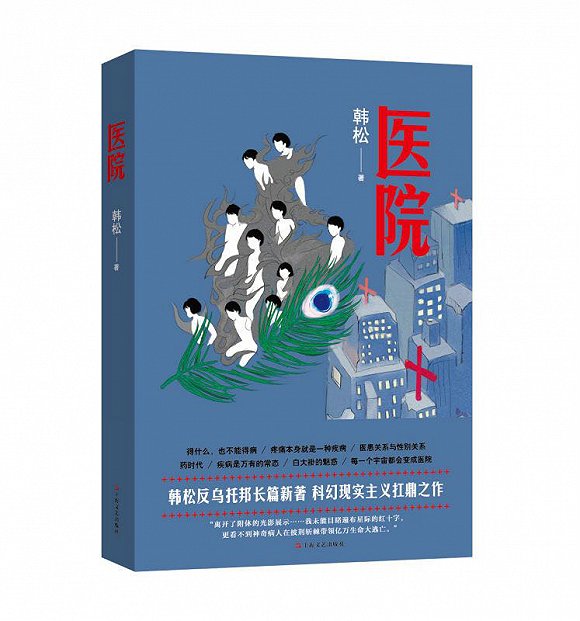
"Hospital" tells the story of the protagonist who has just arrived in a strange city called C. He is inexplicably sent to the hospital because he drank a bottle of mineral water. He feels that he is trapped in a huge conspiracy. Every day he has to face doctors and patients who are half-lived and half-dead, as well as strange diseases. Gradually, he discovers that this hospital has actually expanded to the entire universe. People cannot be cured and cannot leave the hospital, and can only reincarnate between the identities of doctors and patients.
Through this story, Han Song wants to express an ultimate question, "The premise of our existence is imperfection and pain, but we always want to repair this imperfection, but any repair is of no avail. Going to the hospital, taking medicine and paying attention to health are behaviors that pursue the perfection of life forms and try to repair life. It is best for us to keep a distance from hospitals."
Han Song believes that such mysterious and ultimate care is the difference between science fiction novels and pure literature. However, he does not think that science fiction novels are superior to pure literature. On the contrary, "Science fiction novels may die from contempt for literature. Hao Jingfang failed to win the Nebula Gold Award the year before last because the language and structure of the work were very different. There is room for improvement. And there are many better works than this one. Now there are more and more science fiction stories that have reached a level comparable to pure literature, and many works have been published in pure literature magazines. For example, Chen Qiufan's "Ba Lin" was published in "People's Literature" and is also a favorite to win this year."
Conversation
People should admit their shortcomings and keep an appropriate distance from the hospital
Interface Culture: In "Hospital", the hospital is no longer a hospital, but expands to the entire city and becomes the entire universe. What does this mean?
Han Song: The hospital becomes the universe. This is a very real problem. When a person goes to the hospital when he is sick, the hospital is the entire city and the entire universe to him, and his family members are also tied to this illness. This is even more of a science fiction imagination:The rapid development of technology and capital makes “life healthy”Becoming the dominant and central topic in our contemporary society, this topic continues to spread and penetrate into contemporary thought and philosophy.
I once noticed a very sci-fi scene. Nowadays, airline magazines on airplanes have advertisements about gene therapy, and the creators of the advertisements turned out to be alcohol sellers. This shows that the focus of the entire society is shifting - everything from airplanes to cities will be dominated by "life and health". To compare, more than 60 years ago, the average life expectancy of Chinese people was more than 40 years old. Life was like a piece of grass. So many people died in the Nanjing Massacre, but they are all unknown.
Interface culture: It turns out that Chinese people also pay attention to health topics, and there is also the "Huangdi Neijing", right?
Han Song: It’s different. Why weren’t there so many medical disputes in the past? The biggest doctor-patient conflict was between doctors and rulers, not doctors and patients. For example, Bian Que, Hua Tuo and rulers all survived from those in power. Modern medical care is a product of industrial civilization. Just as modern society has destroyed many lifestyles and even national dignity, Western medicine also brought about the "alienation of people" in the early days of capitalism. Therefore, on the one hand, modern medicine saves people, but on the other hand, it cannot get rid of "alienated" people. In our country's transitional period, there is also a "sense of alienation" brought about by medical care itself.
Interface culture: So in such an "alienated" environment, it is impossible for doctors and patients to be completely equal?
Han Song: Equality is impossible. On the one hand, because of the imbalance in information resources and expertise, doctors have control over the lives of their patients, and most patients find it unreliable if they do not give red envelopes. On the other hand, doctors are weak in many situations and are ordinary people in this society. When they take off their white coats, they may be more vulnerable than ordinary people. If the patient is richer, or has more resources in terms of intelligence and power, he can dominate the doctor. Therefore, the novel makes an assumption that the relationship between doctors and patients is mutually transformable. All doctors transform from patients, and doctors will also degenerate into patients again. This recurring cyclical relationship is also the essential problem of the doctor-patient relationship.
Interface Culture: Did you write this book to focus on the real-life contradiction between doctors and patients from a science fiction perspective?
Han Song: Yes, I have this idea.
Interface Culture: The book describes so many diseases, ranging from stomachache to cancer. What kind of assumptions do you have?
Han Song: Disease itself comes from the imperfection of the entire world, or the stipulations of species. Each species has its own life cycle. It is impossible to extend life span against the laws of nature. Disease is the instinct of survival. The imperfection of the universe is the most natural state. No living thing without disease exists. The imperfect design of the universe is the prerequisite for the existence of all things.
Interface Culture: Are you opposed to constant artificial repair and modification of genes?
Han Song: Repairing won’t help.
Interface culture: There is a very profound problem here, that is, on the one hand, people want to cure their own diseases, but on the other hand, in the hospital, not only can the disease not be cured, but it will become more and more serious.
Han Song: My discovery is that if the universe was perfectly designed, there would be a race that would live forever, but there is no such thing because it was designed with such flaws in advance. So I think that all existence is to relieve my pain and illness on the one hand, and needs pain and illness on the other hand. Just like people have flaws, but they are not aware of them, or they are aware but still refuse to admit them. Going to the hospital is a pursuit of perfection.
Interface Culture: What will happen if we don’t pursue perfection?
Han Song: Admit the shortcomings and keep an appropriate distance from the hospital. Go to the hospital, but more naturally, don’t regard doctors as gods or as a place to save lives. Otherwise, the greater your hope, the greater your disappointment. Also, health care programs on TV have the same feeling as preaching in the past. When these "authorities" take off their clothes and step out of the TV, they become very fragile people who need treatment.
Wang Baoqiang and his wife are a pair of patients and have a morbid relationship.
Interface Culture: In addition to the treatment of diseases, the pursuit of perfection also involves the relationship between men and women. Several women appear in your works, and you also treat them in a sexual sense. Many people criticize science fiction literature for portraying women as either innocent, evil, or sexual objects. Do you think there is such a problem?
Han Song: I think people who are interested in science fiction have their own characteristics. They are more interested in things and the world than people. They usually cannot handle interpersonal relationships well, which will also affect their creations. Generally speaking, novels are written by humans, about sentient beings and the sentient world. However, science fiction authors put themselves more like gods. They are most interested in creating a new world and immediately destroying it. They are not particularly interested in the entanglement between men and women.
In the hospital, people's emotions, gender and shame will become indifferent. Many people do not care about their own roles. In novels, when they have sex, they cannot experience the excitement between people and animals. So man becomes a machine for experimentation and masochism, sexual intercourse becomes mutual therapy, and gender becomes a pathological manifestation of a flawed world. In real society, many people complain that they cannot find sincere and imaginary feelings between men and women. Wang Baoqiang and his wife are a pair of patients with a pathological relationship.
Interface Culture: Some people judged you as the ghost of China, but you denied it, thinking that what you wrote was a rising utopia?
Han Song: The ghostly China is what Fei Deuterium said. What he means is that China is a behemoth-like existence that mixes the legacy of the past with the new machinery. We are in it, but we feel very strange at the same time. Utopia means a society that is better than reality.In the past one hundred and seventy years, there may not be a nation in the world that wants to live in a utopia as much as China, eager to pursue a better reality. This pursuit has gone through so much death and suffering.
There is a science fiction story that there are too many people in China. In order to solve the problem of resources and food, they thought of speeding up time, so that everything can grow big, good and fast. But precisely because of this problem, not only food grows tall and fast, but mice also grow tall and fast.Big and fast, so this spooky place in turn eats up the real world. TThis is the world we live in, both a utopia and a ghost world. Utopia taken too far is dystopia, worse than reality. The hospital was supposed to be a place to save people, but it ended up being a place that swallowed people up.
Interface Culture: There don’t seem to be that many people writing about dystopia in China? Youth Adult Distopia is especially popular among teenagers.
Han Song: Dystopias and works about a bad future are difficult to publish. What we can see is the utopia described by Guo Jingming, a world that is better than the present like a dream. By describing dreams, they can ignore the unpleasantness and depression of reality. "If you see it, you can achieve it" has become the main trend of society, rather than "If you see it, you are destined to not get it." Therefore, he can strongly reflect the thoughts of modern young people.
Interface Culture: Is your "Hospital" a dystopia?
Han Song: There are some differences from traditional Western dystopias. "1984" and "Brave New World" are all manifestations of the alienation of human nature under the oppression of a totalitarian system. The core focus of "Hospital" is whether human purpose, gender, family, and the nature of the world are real or illusory. The hospital is a microcosm of the universe, a larger mirror that transcends human society. Hospitals are both technology and nature, both human and non-human. The word "Chinese" does not appear in the book.
"Flowers" lacks a transcendence
Interface culture: This is the ultimate question. Do you think science fiction literature has advantages over pure literature?
Han Song: It’s not necessarily an advantage, but science fiction prefers to focus on these topics, and many short science fiction stories also touch on ultimate issues. Including recent award-winning works, not only those from foreign countries, but also domestic Nebula and Galaxy Award works will all point to the ultimate question, but this is not necessarily true for mainstream literature. Although I admire them for their ability to describe reality vividly and with great pyrotechnics, that is where it ends. For exampleThe Three-Body Problem points to the ultimate from the first sentence of the first chapter of the first part, while many people point out that "Flowers" lacks a kind of transcendence.
Interface Culture: However, the title page of "Flowers" says, God does not ring.
Han Song: But when I read it, I felt like I couldn’t understand the existence of God.
Interface Culture: At the science fiction conference at Fudan University in June this year, science fiction writers were very optimistic about science fiction literature, and believed that science fiction literature could surpass pure literature in the next few decades?
Han Song: I said at the time that there are two things that may destroy science fiction. One is capital and IP hype, and the other is literature. When they don't understand, they think I'm saying that pure literature is no longer good. What I want to say is that the peak reached by pure literature is beyond the reach of science fiction literature. If science fiction is isolated from literature, there will be no future if we underestimate literature. Therefore, science fiction literature must have similar requirements to literature, while retaining its characteristics.
For example, Hao Jingfang won the silver medal at the 2014 Chinese Nebula Awards. The reason why she did not win the gold medal was because of her language and composition.There is room for improvement in composition, and there are many works that are better than hers. For example, I remember that the work "The Image Maker" by Chen Qiufan that also won the silver medal was better than "Beijing Fold" by Hao Jingfang. It is a classic from the perspective of science fiction and literature. But it may not be suitable for foreign tastes, and it has no translation, so it has not received attention. Another problem is that many works that have won many awards in China have neither attracted attention nor been discussed. This is actually very abnormal.
Interface Culture: What is the difference between foreign tastes and domestic tastes in science fiction?
Han Song: Some domestic science fiction works are combined with history, but foreigners don’t quite understand it. Others have different tastes in terms of feeling, imagery, and atmosphere.
Interface Culture: Why do you think Chinese people don’t pay attention to or be interested in science fiction?
Han Song: Because science fiction, like hospitals, is a product of industrial civilization. It only came into existence after the British Industrial Revolution in 1818. China is an agricultural civilization and has long been more interested in the relationship between men and women, such as "The West Chamber", or fantasy, such as "Journey to the West" and "Liao Zhai", and then there are public case novels. Science fiction is a strange import.
Interface Culture: How do you evaluate the reading threshold of science fiction works as a genre of literature?
Han Song: Science fiction is relatively difficult to read among several types of literature. Fantasy and fantasy are easy to read. "Tomb Robbers" and "Zhu Xian" can draw people in at once. Mystery novels, romance novels, horror novels, and martial arts novels all have a low threshold for reading. Science fiction often introduces knowledge of physics and astronomy at the beginning. Many Chinese people are not interested in it. Only by reading with certain knowledge can one understand the author's intention.
Interface culture: Since the reading threshold is high and not many people are interested, do science fiction writers consider readers’ acceptance when writing?
Han Song: Very few. When I started writing, there were even fewer people reading science fiction, so when I wrote it I just based on interest, without thinking about publishing it, and not knowing where the readers were. Now it has become a habit. The good thing is that it is not restricted and can break the boundaries of reality. I have seen some pure literature authors who first consider publishing and winning awards before writing a novel. However, Liu Cixin and Hao Jingfang definitely did not expect to win awards when they wrote it.
It was difficult for Liu Cixin to publish "The Three-Body Problem" at first, and it was also difficult for Hao Jingfang to publish "Beijing Folding". Later, it was published in Dean's "Literary Style Appreciation". Many of the Chinese-language Nebula Award novels are now published in "Literary Style Awards" and "People's Literature". Chen Qiufan's "Ba Lin" is a favorite for the "Galaxy Award" that will be judged this year. It is not published in "Science Fiction World", but in "People's Literature". Having said that, "Science Fiction World" is very small and has many contributors, but the quality varies.