
Yokosuka City is located at the estuary of Tokyo Bay. It is the gateway to the capital Tokyo and the place where the famous "Black Ship Incident" occurred in modern Japanese history. A famous attraction here is Perry Park. The park faces the sea and occupies a small area. The most conspicuous thing is a majestic stone monument with the Chinese characters "Monument for the Landing of Admiral Burley of the United States Navy of the United States of America" written in Ito Hirobumi's handwriting. Instructions are engraved on the base of the monument in English and Japanese respectively——
On July 8, 1853, Perry, the commander of the East India Fleet of the United States of America, landed on the Kurihama coast of Uraga and delivered President Fillmore's personal letter to the Edo shogunate. The following year, a treaty of friendship between Japan and the United States was concluded in Kanagawa. This series of events became the driving force that brought Japan, which was in a state of isolation under the shogunate, back to the world.
There is also the Perry Memorial Hall in the park, with a statue of Perry erected in front of the door. There are two other sculptures of the same kind in Japan, one in Tokyo and one in Hokkaido.
Like China, Japan also implemented a "lockdown policy" for a long time. It was not until Perry led a US warship into Tokyo Bay that it was forced to open its country. There is no doubt that Perry was an invader, but why did Japan erect a monument to an invader? The answer may lie in history.
The policy of seclusion has been strictly implemented for more than 200 years, but Japan is not closed-minded like the Qing Dynasty. Instead, it has always retained information channels to observe the outside world. The shogunate allowed Dutch and Chinese ships to enter the port of Nagasaki for trade, but the Dutch had to report overseas information every year, and the Chinese merchant ships had to report the situation in China.
Not long after the Opium War broke out, the news reached Japan almost immediately. China has a vast territory and strong national power, but it was defeated miserably at the hands of the Western "barbarians". While Japan was shocked, it also quietly softened its isolation policy. Previously, the shogunate had issued an order to expel any foreign ship (except Chinese and Dutch ships) approaching the coast of Japan, regardless of the circumstances, by firing cannons immediately. But in 1842, just as the Opium War was extinguished, the shogunate issued a "salary order" that could provide fuel, food and water to foreign ships, but then ordered them to leave Japan as soon as possible to prevent unprovoked war.
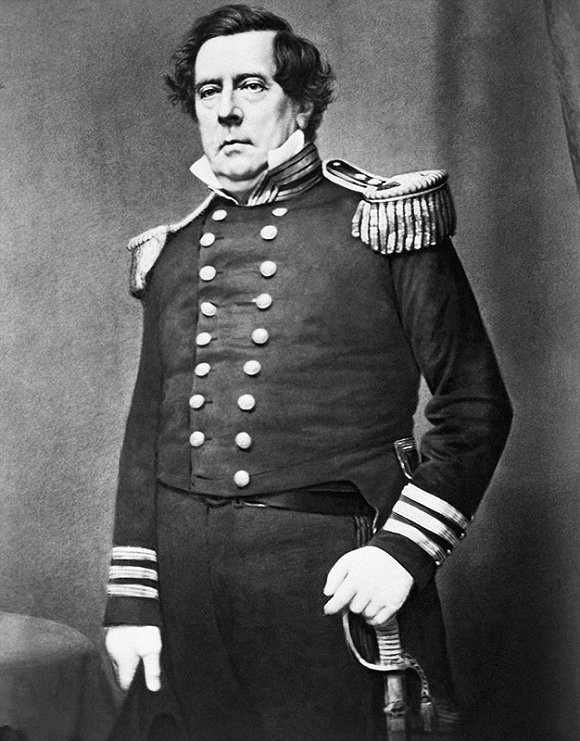
Perry
"The exchanges between the various countries on the earth are becoming increasingly close. An irresistible force is bringing them together. The invention of the steamship has made the distance between each other smaller." In 1844, the King of the Netherlands wrote to the shogunate, asking for a freer way to solve foreign trade problems, warning that Japan may suffer the fate that China has suffered. "In this period of rapid development of relations, countries that tend to remain isolated will inevitably become enemies of many other countries."
The Tokugawa shogunate responded that the Seclusion Order could not be abandoned, "Since the laws of our ancestors have been enacted, future generations must abide by them."; This argument is so similar to the Qing government’s claim that “the laws of the ancestors are immutable”! However, Japan does not close its eyes and listen. Instead, it pays close attention to changes in the outside world and captures various information.
The year before Perry's voyage, the report submitted by the Dutch in 1852 accurately reported that the United States would send the Perry fleet to Japan to demand Japan's founding of a country. It even stated the fleet's ship name, tonnage, number of guns, number of crew and other information one by one. Therefore, the shogunate already knew the information about Perry's voyage, unlike the rulers of the Qing Dynasty who knew nothing about the outside world.
Facing the US fleet, Japan knows that its national strength is insufficient, and if it resists, it will inevitably make the same mistakes as China. Therefore, it did not take fierce confrontational measures, but calmly avoided the fight, resigned and sent Perry away.
On February 13, 1854, Perry came to Japan again. This time he led a fleet with three more ships than last time, and did not stop in Yokosuka. Instead, he went deep into Tokyo Bay and anchored in the waters of Yokohama, demanding a clear answer to the letter from the US President he brought last year.
This time the shock to the shogunate seemed to be greater than last time, because the situation was obvious and it was impossible to find excuses to send away the uninvited guests like last time. "Modern Japanese Political History" describes the panic of the rulers at that time -
The U.S. warship sailed from Uraga on January 28 (Japanese calendar) and anchored in Kanagawa Bay. The shogunate was horrified when they saw this, believing that the U.S. warship would bypass Haneda Beach and enter Shinagawa. If the negotiations broke down, Edo would be reduced to smoke under American cannon. From Kanagawa to Edo, lookout locks abound, and urgent letters fly like snowflakes. At the castle where the shogun was stationed, I suddenly learned that the barbarian ship was sailing to Edo, and I was frightened. Suddenly I learned that the barbarian ship was sailing to Uraga, and I was relieved. Just like this, he was suddenly frightened and relieved, several times a day. After a detailed investigation of the reason why the barbarian ship turned its rudder, it was said that due to the rise and fall of the tide and the change of the wind direction, the barbarian ship changed direction at the moored spot. The outpost reported this, causing a false alarm and so on.
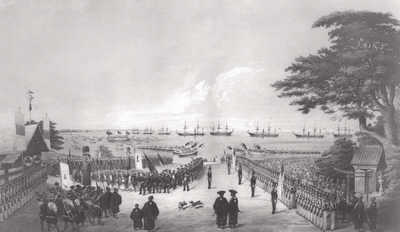
Black Ship Incident
In desperation, the shogunate had to sit down for formal negotiations, and finally formally signed the "Japan-United States of America Peace Treaty", agreeing to open ports such as Shimoda and Hakodate, and the United States could send consuls to Shimoda, etc. This was the first international treaty signed between Japan and a Western country, and also marked the formal disintegration of Japan's seclusion system. Perry wrote this in his report to the U.S. Congress——
Japan has opened up to Western countries - it is the duty of Western countries to explain to Japan that her interests will expand with her interactions with them. And, as prejudice gradually disappears, we can look forward to seeing more and more free negotiations on commercial treaties in the future.
Without firing a single shot, Japan's door was opened at the right time. It was the middle of the 19th century. Although advanced countries had completed their industrialindustrial revolution, but their technical level is still at the stage of improving proficiency and accumulating experience. The modern steel industry had just begun, and the boom in railway construction had just begun, but sailing ships had not yet been replaced by ships. Therefore, Japan's technological level does not lag far behind the advanced Western countries. After completing the political system reform through the Meiji Restoration, the Japanese worked hard to catch up and became the most powerful country in Asia in just over thirty years, leaving China far behind.
Without Perry, Japan might have remained insular and eventually become a colony. Perry's arrival indeed "became the driving force that brought Japan, which had been locked down under the shogunate, back to the world." It is unbelievable to the Chinese to give such a high evaluation to an invader. However, if we strip away the moral judgment and measure it by historical standards, there is nothing wrong with this evaluation. The modern Japanese thinker Yukichi Fukuzawa once wrote: "The coming of Americans across the sea seems to have ignited a fire in the hearts of our people. Once this fire is ignited, it will never be extinguished."
If China and Japan swap places, can China learn lessons, face reality, abandon its seclusion policy, and integrate into the modern world trend like Japan? Obviously impossible. It’s not that history has never given China a chance. "Black Ship Incident" 50 years ago, the British sent a mission to Beijing to request trade, but Emperor Qianlong flatly rejected it. If China had opened up its doors at that time, it would have been able to catch up with the first train of the Industrial Revolution and avoid many historical detours later on.
History cannot be assumed, of course, but it can inspire our thinking. When facing history, can we think more calmly? Over the past 100 years, in addition to the invaders who fought openly, there have also been many foreigners who have contributed to the progress of China's civilization. Should we give them a minimum of respect? For example, Leighton Stuart, who founded Yenching University and cultivated countless talents, shouldn’t a statue of him be erected on the campus of Peking University?