The format of books is changing. Electronic books, or ebooks for short, are more portable than paper books, and people can fit hundreds of them into a reader or tablet device. Access more resources with just a click. Some people believe that e-books are more durable than traditional paper books: a reader may be stolen or dropped into the bathtub, but the content of the book is safely stored in the cloud and can be downloaded to a new device at any time. Needless to say, books and the form of reading are in the throes of change.
However, not everyone is happy to hear this change. Bibliophiles, publishers and booksellers are all taking a keen interest in the sales war between traditional books and e-books, as Tom of The Bookseller magazine When Tivan claimed in his report that e-book sales had declined for the first time, there was relief between the lines: "Those who predicted that physical books will die out this decade and e-books will dominate the market may have to re-evaluate after seeing the sales comparison of the two in 2015." For now, paper books may have the upper hand, but the debate over which is better is far from settled.
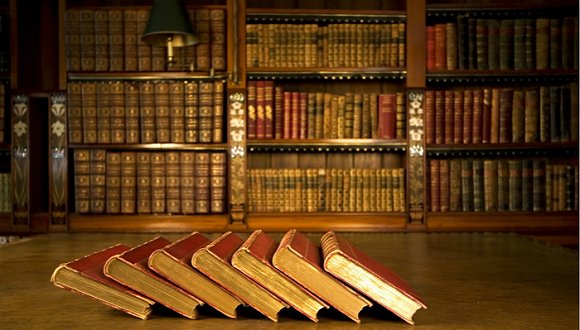
Interestingly, people today's anxiety about the change in book form is exactly the same as a similar event in history. Two thousand years ago, a new and unconventional book would completely overturn the existing tradition and make the readers of the time suffer.
"Let it go"
Rome in the first century AD was a sea of words. Elegant, solemn and heavy capital letters are engraved on exquisite statues and majestic monuments; citizens use wooden writing boards to record events and convey news; and the libraries of dignitaries are filled with historical, philosophical and artistic works. But these books are not familiar to us - they are scrolls, rolls made of Egyptian papyrus and ranging in length from 4.5 to 16 meters (14.76 to 52.49 feet). Although they were widely available and widely used at the time, they still had some drawbacks.
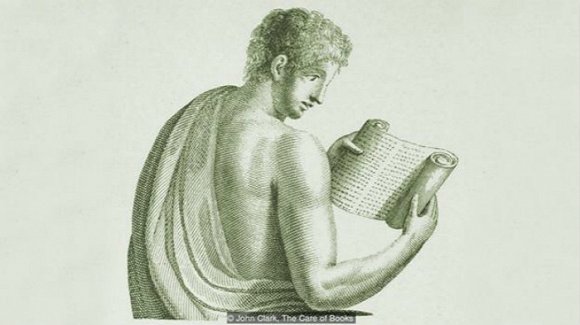
Image source: John Clark, "The Care of Books"
For example, both hands must be at hand to write freely on the scroll. Unless the reader is sitting at a desk (in which case the rebounding papyrus can be held in place with a paperweight or wooden clamp), the only way to read is from right hand to left hand.Unroll the scroll gradually and carefully. Writers and copyists often wrote in columns several inches wide to allow the fragile papyrus to be rolled up safely. Even so, historians have discovered that the bottom edges of many scrolls were damaged by friction with readers' clothing.
Secondly, papyrus itself is not an easy material to preserve, especially after leaving the hot and dry climate of the Mediterranean. Tacitus, the Roman emperor from 275 to 276, out of admiration for the historian Publius Cornelius Tacitu of the same name, sent the latter's works to Gaul and Germany every year to replace the decaying old copies. Papyrus is also very susceptible to breaking and tearing after repeated folding, a property that not only gave rise to the shape of the scroll - but also forced people to write on only one side of the scroll. Only when the content on the front of the scroll was no longer important would its owner turn it over for use; otherwise a scroll with content on both sides would be difficult to read.
“Confusing”
Around the 1st century AD, a new type of book came into being, and its arrival was about to solve all the shortcomings of scrolls. The evidence for its existence is sparse but conclusive: archaeologists have discovered a few fragments of papyrus, with text unexpectedly extending from the front to the back, and the margins of the pages also have the usual white space in a page-turning book. These fragments are part of the world's first page-turning books. We now know that the ancient Romans called this new type of book a "codex" (annotation: the word comes from the Latin "caudex", which is the root of a plant or tree because it resembles the wooden board the ancient Romans used to write on), but the invention of the codex is still a mystery. The earliest surviving written record of a codices comes from the Roman poet Martial, who encouraged readers to purchase his work in the form of a flipbook:
"People who hope that my work will always be with you, travelers who want to walk and read, come and buy a small, parchment flip book with rich content! Leave your scroll box to the great writers, my new book can be at your fingertips!"
Marshall's advertising slogan, written between 84 and 86 AD, not only tells us that flipbooks were already widely known at the time, but that at least some of them used a new material called parchment. This alternative to papyrus originated in a Greek city-state centuries ago. It uses stretched clean animal fur as raw material and is made through a bloody and arduous process, but its smooth and strong qualities made it an ideal writing material at the time. According to archaeologists, Marshall's slogans and fragments of ancient books can be traced back to the first century AD. Apart from these tantalizing evidences, we know very little about the birthplace and origin of the manuscripts. Even whether the first codices were made of papyrus or parchment, no satisfactory answer has been found.
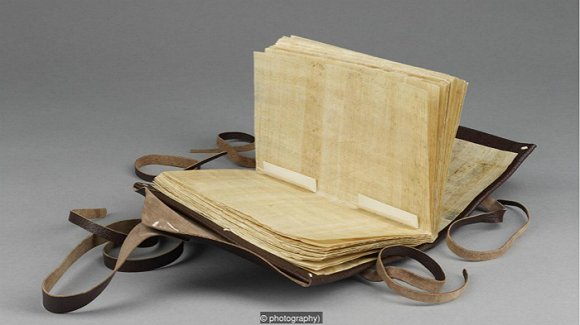
Durable, efficient, and user-friendly, written by TranscriptIt is truly an epoch-making invention
Whatever the truth, flipbooks are a big step up from scrolls. The codices were bound by a wooden cover or "board" (made from several pages of scrap papyrus or parchment glued together), which protected them from the hands of unwary readers. The easily paged nature of their pages and their ever-increasing number of pages also paved the way for indexes and catalogs. Codices also had the advantage of being space efficient, as they could carry more information than scrolls of the same size. When referring to the works of the prolific writer Titus Livius, Marshall praised: "Titus is full of economics, but his body is full of oxen, and his parchment is light and durable, and there are thousands of words in his pages." Because of its durability, efficiency, and people-friendly advantages, the codex can truly be called an epoch-making invention.
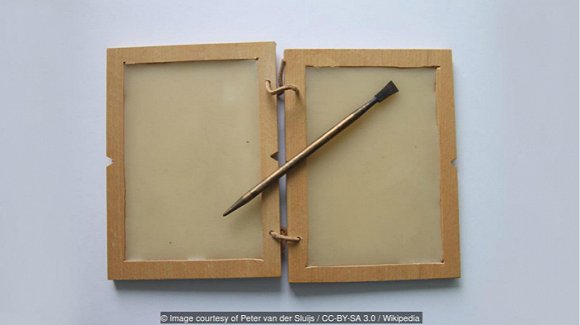
People in Rome and the surrounding lands were divided over the manuscripts. Roman irreligious people, as well as ancient Jewish sects, preferred the familiar scroll form; on the other hand, the empire's rapidly expanding Christian community enthusiastically mass-produced page-turners, including the Gospels, series of biblical commentaries, and esoteric wisdom. Of course, we know how the story ends: By the 6th century, both paganism and the scrolls were on the verge of extinction, and Judaism was firmly surpassed by its younger descendants.
Following the lead of the Christian Church, flipbooks found their place in history and society.
The e-book of the 21st century may not have the devout following of ancient manuscripts, but it inspires deeper thought. Will it be its turn to replace paper books? Or is it the one that will go the way of the reels? Time, and booksellers’ profit margins, will tell.
Keith Houston's book: "A Cover-to-Cover Exploration of the Most Powerful Object of Our Time" was published by Norton Press this month.
(Translation: Li Xue)