
European-style buildings and criss-crossing roads are full of lights and busy traffic at night. This is the Bund, one of the Shanghai Concessions from 1843 to 1945. It has witnessed the comings and goings of people over the past hundred years, and also carries the ups and downs of modern history. Writer Mao Dun described the Shanghai Concession in his article "Bodybuilding" - "Our ten-mile foreign land is really nothing more than a deformed colonial capitalist society." Is the Shanghai Concession Really a Colony? A few days ago, Xiong Yuezhi, president of the Shanghai Historical Society, gave a negative answer at a lecture at Dayin Bookstore: The concession is by no means a colony.
"The nature of the concession should not be whatever the imperialist countries want. It is the result of the intricate influence of multiple reasons." Xiong Yuezhi emphasized. He believes that the concession is to rent a piece of land to foreigners for living and doing business at a certain rent, rather than ceding the place. For example, the rent of the Shanghai concession is 1,500 yuan per mu of land per year, and the rent payment time is before December 15 of the Chinese lunar calendar. This also means that the sovereignty of the concession still belongs to China.
There are few people in the French Concession and they are poor, so missionaries need to plan well
In 1843, China and Britain signed the "Treaty of Humen", opening five ports including Guangzhou and Shanghai to trade. Two years later, Shanghai had its first concession, the British Concession, which is today's Bund. In 1848, the American missionary Wen Huilian came to Shanghai to propose the establishment of an American concession. Finally, he obtained the government's verbal consent and merged with the British concession on September 21, 1863 to form the British-American concession. In 1849, the government designated a French Concession near the then county seat of Shanghai. Xiong Yuezhi said that unlike the British and American Concessions, the French Concession had very few people and business was not prosperous, but there were many missionaries. While preaching, they also brought more French culture.
The French Concession is also different from the British and American Concessions in terms of land lease and management methods. The French Concession adopts "official leasing", that is, the Chinese government leases all the land in the concession to foreign governments, and the foreign government sub-leases the land to overseas Chinese businessmen in that country; the British and American Concessions adopt "private leasing", allowing foreign businessmen and ordinary people to negotiate on their own. After the negotiation, both parties sign a contract and the government agency stamps the result. In the French Concession, the French consul is the highest official in the French Concession and decides on major issues in the concession; the British and American concessions have election and voting mechanisms, and the management method is more democratic than the French Concession.
Xiong Yuezhi said that one of the characteristics of the French Concession is its "integrity", which not only considers the overall municipal facilities, but also reflects the characteristics of the Republic. On the Bund, you can see winding roads, but in the French Concession, the roads are well planned, and the different types of buildings in the area, such as factories, residences, etc., are also well-proportioned.
In 1899, the British and American Settlement was renamed the International Public Settlement, and its area expanded to 33,503 acres (22 square kilometers): east toZhoujiazui (now the corner of Pingliang Road and Jungong Road) reaches Jing'an Temple in the west. The entire concession is divided into four districts: central, north, east and west. The expansion of the scope also deepened the impact of the concession on Shanghai's politics, economy and culture.
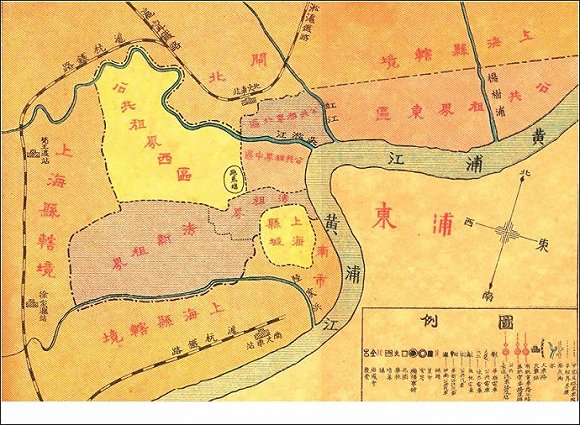
Among the 26 concessions in the country, the British Concession in Shanghai was the earliest to be established, and the total area of Shanghai's three (later became two) concessions was also the largest. "To add up the 23 concessions in the country, multiply by 1.5 to equal the area of the two concessions in Shanghai." Xiong Yuezhi described the "bigness" of the Shanghai concessions after 1899. In addition, he believed that Shanghai's concession system was the first in China and provided a model for the establishment of other concession systems later, but "each concession has its own characteristics."
Chinese can also live in the concession if they buy a house or pay rent
Xiong Yuezhi also emphasized that over the past century, although the management of the Shanghai Concession has been criticized, it has always maintained the characteristics of "autonomy" and "rule of law." According to regulations, all fiscal revenue from the Shanghai Concession must be used in the Concession, and the management agency is required to publish all revenue and expenditure every year. The British and American Settlement (International Public Settlement) elected all directors through the tenants' meeting (later changed to the taxpayers' meeting). Not everyone has the right to vote: On December 30, 1863, the land tenants' meeting resolved that all tenants in the concession who owned land with an assessed land value of 1,000 taels or less than 1,000 taels were entitled to one voting right; for every 1,000 taels the land valuation increased, one voting right was added. It was also stipulated that anyone who paid more than 500 taels in house rent could also get one voting right.
The rule of law is implemented within the Shanghai Concession, and each item has very detailed regulations. The United Kingdom moved its four judicial systems to the International Settlement. Among them, Xiong Yuezhi thinks the most bizarre thing is the Consular Court, a court that specifically targets Chinese government agencies such as the Shanghai Bureau of Industry and Commerce and the Administrative Tribunal. If foreigners in the concession are dissatisfied with the Chinese government, they can sue them. In the consular court, imperialist countries do not have special applicable laws. The consuls just discuss together how to decide the case. From 1882 to 1943, cases resulted in either parties settling, or the plaintiff losing. Most of the cases ended with the Chinese government losing.
In terms of residence, at first the Shanghai Concession implemented the "Huayang Branch" policy, and Chinese people were not allowed to live there. Later, the "Little Knife Society Uprising" changed this situation. In August 1853, Liu Lichuan and Pan Qiliang led the Xiaodao Society to launch an uprising in Shanghai and quickly occupied Shanghai County. Seventeen months later, in February 1855, the Xiaodao Society was suppressed, the uprising failed, and the population of Shanghai County dropped from 350,000 to only 40,000. Where has everyone else gone? A considerable number of people fled into the concession. The population in the concession increased sharply, and many problems such as sanitation and management emerged. At that time, the Shanghai government was no longer able to care about this matter, so it had no choice but to leave it to the concessions themselves. In 1854, the voting rights of the British concession merchants voted to allow China toThe prerequisite for people living in the concession was that the Chinese had to pay rent or buy a house, which lasted until the Shanghai concession was taken back.

The concession is not a colony, but it has colonial characteristics
According to Xiong Yuezhi, although the Shanghai Concession was not a colony, it had a very important characteristic: it was so colonial that the Chinese government later had no way to manage it. The most prominent point was that Chinese patrols were not allowed to enter the Concession to arrest people. This situation lasted from the late Qing Dynasty to the Republic of China. In addition, since the 1860s, the Shanghai Concession has always remained neutral during Sino-foreign wars or wars between foreign countries, such as the Sino-Japanese Sino-Japanese War of 1895, the Russo-Japanese War in 1904, and even the Revolution of 1911, which also made the Concession a relatively safe place.
The fact that the army is not allowed to pass also reflects the colonial characteristics of the Shanghai Concession. Whether it is the Chinese army or the army of other countries, as long as it passes, it must disarm. During the Anti-Japanese War, Sihang Warehouse passed through the concession alone and was disarmed.
Xiong Yuezhi used the word "wonderful" to describe the return of the Shanghai Concession. In 1943, before the Second World War ended, the Japanese returned all the Shanghai concessions they occupied to the puppet government of Wang Jingwei in order to show goodwill to China. After the handover, the puppet government changed many roads named by Westerners in the concession to Chinese place names, such as Tibet Middle Road. However, it was not until the end of the Japanese war of aggression in 1945 that the Shanghai Concession truly returned to Chinese hands. "Legally, the Shanghai Concession survived for 98 years from 1845 to 1943; but in fact, it existed for exactly 100 years, that is, from 1845 to 1945, a full century."