
In 1854, Perry led the U.S. fleet into Tokyo Bay for the second time and landed in a small fishing village called Yokohama. Just thirty or forty years later, the desolate fishing village miraculously turned into a prosperous city. The "Yokohama Port Opening Museum" vividly tells the history of a city's growth with a large number of materials. One of the pictures, "Americans Responding", attracted me.
This is the work of the famous Japanese painter Akako Shogata, who was commissioned to portrait the visitors on the "Black Ship" one by one. I was surprised to find in the painting that among a group of Americans, there was actually a man wearing a melon cap and long braids. Are you Chinese? If you look closely, you will see that this person has a round face, is short and fat, and is holding a folding fan. Next to the portrait is written "Rosen from the Qing Dynasty". Sure enough, he is Chinese! I also found several other portraits of him holding an umbrella, shaking a fan, and writing. Rosen's name can often be seen in the notes, diaries and records of talks between the two sides of the Japanese personnel who attended the reception of US representatives at that time. This means that there was a Chinese who witnessed the historical scene of the founding of Japan.
What legendary experience does this Chinese have that he actually participated in Japan’s historical process and witnessed Japan’s historic moment?
After checking the information, I found out that Rosen was a scholar from Nanhai County, Guangdong, and later went into business. When he lived in Hong Kong, he had contacts with British and American missionaries. He spoke a little English but did not understand Japanese. What is incredible is that he actually came to Japan with the American fleet as a translator.
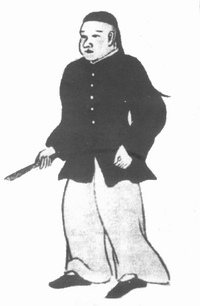
During Perry's first trip to Japan, he was translated by the famous American missionary S. Wells Williams. Wei Sanwei felt that Chinese was indispensable for dealing with the Japanese and making agreements, so when the Perry fleet went to Japan again, he invited his friend Rosen to accompany him and serve as the translator for the American fleet.
At that time, the Japanese basically did not understand English, and few people in the United States were proficient in Japanese. Rosen did not understand Japanese or Dutch, but he could "talk" with Japanese people on paper using Chinese characters, because Japanese officials and scholars at that time were all familiar with Chinese characters. Almost all translations relied on Rosen and Wei Sanwei. So there was a strange negotiation scene: the American negotiator used English, Wei Sanwei interpreted it into Chinese, Rosen wrote it down and showed it to the Japanese officials; the Japanese official wrote it in Chinese, Rosen read it out, and Wei Sanwei translated it into English for the American officials. This is a rare anecdote in the history of diplomacy.
The negotiations between the United States and Japan lasted for nearly a month, and the two sides were heavily guarded during the negotiations. Rosen wrote in his diary, "At the beginning, the two countries had never known each other and each had their suspicions. There were also hundreds of Japanese official boats anchored on the far shore, all with cloth sails, and military camp equipment was also prepared to prevent unkindness." In the end, Japan had to accept the conditions of the United States. On March 31, 1854, Japan and the United States formally signed the Treaty of Peace between Japan and the United States of America. This was the first international treaty signed between Japan and a Western country, and also marked the formal disintegration of Japan's seclusion system. It might have beenThis is how Japan's "Opium War" ended.
While in Japan, many Japanese people took the initiative to communicate and have written conversations with Rosen because they were shocked by China's disastrous defeat in the Opium War and were eager to understand what happened in China. Rosen introduced the political situation in China at that time to Japanese people, and also lent his pamphlet "Nanjing Chronicles" about the Taiping Rebellion to Japanese officials for reading. This work was soon translated into Japanese and renamed "The Records of Xianfeng Rebellion in the Qing Dynasty" and was widely circulated in Japan.
At that time, many Japanese elites also lacked understanding of the modern world. A conservative Japanese official wrote a letter to Rosen in Chinese, arguing that Japan should sever ties with foreign countries because outsiders often deceive stupid citizens. They are only interested in profit and have no courtesy and trust. The official also proposed that he would travel around the world on foreigners' "fire ships" and promote the teachings of Confucius and Mencius to people all over the world. Although the idea was naive and ridiculous, the Japanese people's willingness to understand the outside world and the courage to face the outside world was exactly what the Chinese people at that time lacked.
This is the case for Rosen himself. He did not dwell much on the Japan-US negotiations themselves, but looked at Japan with curiosity. In the book "Japan Diary" he later wrote, he described a lot of the "weird" aspects of Japanese society. Rosen compared Japan with China everywhere and was very disdainful of Japan's various "backwardness". For example, he used the Confucian ethics of "no intimacy between men and women" to describe the common bathing of men and women in Japan. "There are bathing rooms where men and women bathe in the same room without being afraid of others." He vilified the simple and natural relationship between men and women into a society where men and women have promiscuous relationships.
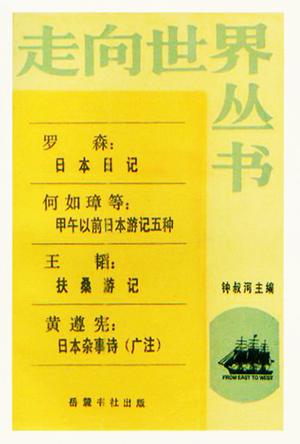
Although Rosen also has admiration for Japan, his writings reveal more of the superior mentality of the Celestial Kingdom looking down on the barbarians in the East, which means that he considers himself a "civilized man". The Opium War has happened for more than ten years, and China has been pushed into the door of the world. It is ridiculous that Rosen still has this mentality. What is even sadder is that he did not realize that the events happening around him were about to change the history of Japan and the destiny of China.
It is indeed a bit demanding to ask Rosen to have a keen historical perspective and issue an early warning to China. However, at a turning point in history, a country needs a group of people with vision. One of the surprising phenomena of Japan in the mid-nineteenth century was the strong desire of educated Japanese to observe the outside world. On the other hand, China at that time was still unwilling to take the initiative to go global even though it could not adhere to its seclusion policy after the Opium War. Countless scholars are obsessed with ancient civilizations and think that they are a great civilization in the East. They are unaware that the world is undergoing great changes. It was not until the Sino-Japanese War of 1894-1894 40 years later that they suddenly woke up and discovered that Japan had left China far behind and could not catch up.
After the negotiation, Rosen took theU.S. warships return to China. It is said that when passing through Zhenhai, he purchased a batch of raw silk there and made a fortune after transporting it back to Guangdong. Translation is temporary, history is not that important to him, he is just a small businessman.
Countless ordinary people live in the cracks of history, living quietly and dying silently, leaving no trace in this world. Rosen was lucky. An accidental opportunity allowed him to squeeze into big history, although he did not know that he had witnessed a great historical moment, let alone the significance of the founding of Japan.
Even if squeezed into big history, small people will still be small people.