
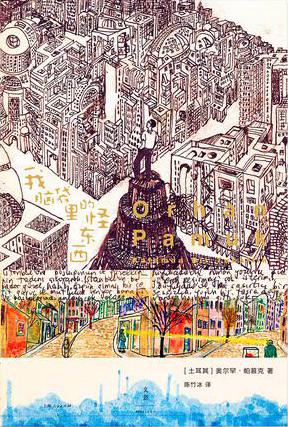
"Strange Things in My Brain" tells the story of the "Yipiao" people, or in fashionable terms, it is a spiritual history about the hardships that Turkish farmers went through to make it to Istanbul.
For Chinese readers who are experiencing urbanization, the stories, scenes and symbols in it inevitably exude a familiar and friendly atmosphere: rental houses in the urban-rural fringe, itinerant vendors who evade and bribe the urban management, nail households who fight against developers, a city full of charming temptations and dangers that is difficult to integrate, people who cannot leave but come back again The countryside that cannot be visited, the gray network between the underworld and hometown organizations, the gray area of activity between legality and illegality, and the confrontation and cooperation with the state, the conflicts between tradition and modernity, religious norms and real life, hopes and dreams and daily trivialities, family affection and real interests, which tear apart people's minds and personalities, etc.
This novel can be read as a documentary. Although the religious part may be a bit foreign, this work should be regarded as the one that Chinese readers feel the least "separated" among all Pamuk's works. This may be more because the hearts of all urban wanderers around the world are connected, whether they are "Yipiao" or "Beijing Drifter", whether they are in Beijing, Shanghai, Guangzhou, Shenzhen, Mumbai, Rio or Mexico City.
If you have read "City of Settlement" before, it will help you enter the narrative scene of this book more quickly, because "City of Settlement" has a dedicated chapter about the expansion of Istanbul in the process of urbanization in Turkey. How farmers "go to the city" is a common issue faced by developing countries in recent decades. Compared with the almost inactive slum model in Mumbai, Rio and Mexico City, and the strict prevention model of some centralized countries, Istanbul has taken a "middle path": first, " "Farmers entering the city are allowed to occupy urban villages and urban-rural fringe areas, which are either owned by the state or owned by fleeing Greeks, but whose property rights are generally in a virtual "ownerless zone," and then the state comes forward to grant corresponding property rights to these illegal residents, thereby legalizing their living conditions and incorporating them into the urban management system. This is also the model advocated by de Soto in "The Secret of Capital," which is similar to the model in which the U.S. government empowered "illegal" pioneers in the West based on the "Homestead Act."
It should be said that the state is not entirely a "benevolent" role in this process, and those who benefit most are not the farmers who have squeezed into the city with their flesh and blood, but those who have rushed to "illegal" services before the state. The "occupiers" are the district government who issues various "certificates", and capable people with multiple identities such as village association leaders, political party branch leaders, and underworld leaders who rush to seize small plots of land from farmers before real estate development.
But in any case, this urbanization method provides farmers with access to the city. After all, those lonely and brave pioneers who left their wives and children can save more or less the first pot of gold in the process of legalizing property rights, and also have a place for future generations to continue to climb the urban ladder. Those political parties, religious groups, hometown associations and other organizations that "mediate" between farmers and the state, although they are not afraid to squeeze and exploit in various interest distribution and exchanges, after all, to a certain extent, they play the role of organizational ties, support networks and resource supply for farmers in cities.
The fundamental reason why all this happened is that the farmers who moved to the city still had votes that could play a role in electoral politics where political parties compete for positions. Although the election results were occasionally changed by military coups, the model of exchanging citizenship rights for citizens continued to operate. In this sense, reading this novel will also be helpful for understanding the changes in Türkiye's domestic political situation.
It can be said that, through his superb narrative ability and diverse literary expression techniques, Pamuk gave Turkey's urbanization process and political and economic changes a full sense of reality and history with flesh and blood. However, it must be stated that this is the reading of a person who likes to study urbanization. If we put aside these political and economic perspectives, we must admit that as far as the story itself is concerned, its exquisite structure and skillful narrative advancement are enough to provide sufficient aesthetic pleasure.
Or it can be said that while the so-called novels with a realist complex eager to reflect the big history subconsciously use the historical background as the background wall of the narrative, Pamuk cleverly and quietly internalizes the thrilling historical events and trends into various embellishments and decorations in a beautiful story, but at the same time still gives the story a heavy sense of history and a grand picture.