
In recent years, "Chinese Studies" has become very popular, which reflects that with the rise of China and the increasing wealth of the Chinese people, people who have been mentally displaced for a long time have an urgent need to seek recognition of their own national cultural values.
However, the lust for power and the stench of copper that comes with the noisy "Chinese Academy" and "Confucianism classes" often make people feel ungentlemanly and disgraceful; and those who hang out in these vanity fairs are mostly unlearned and unskilled charlatans, which makes the real disciples of Confucius and Mencius sad.
So, when I read "Confucianism Fever: Worship Confucius or Brother Kong Fang" published by Professor Zhang Sheng from the Chinese Department of Tongji University on September 13th on the Glacier Think Tank? ”, and I fully agree with its basic point of view in criticizing my alma mater, Fudan University, as a well-known national first-class university for rashly opening the “Shanghai Confucian College”.
However, I disagree with the deeper objections expressed by Zhang Sheng in his article. In his opinion, traditional Chinese culture represented by Confucianism contains too much "sand" and "dregs", and excessive promotion of them is not conducive to cultivating the independent personality and free spirit needed by modern society. He even quoted Mr. Hu Shi's comments nearly a hundred years ago, calling political Confucianism a technique that allows people to become "slave owners" or "slaves" safely. I particularly disagree with this.
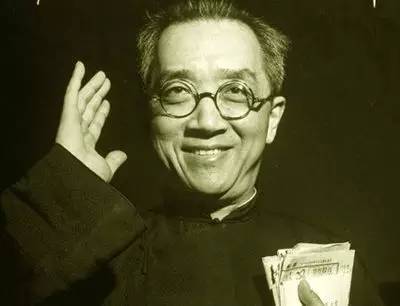
Hu Shi
I believe that this kind of radical anti-traditional thinking that originated during the May Fourth Movement has been proven wrong and has caused endless harm in China's difficult and tortuous modernization process over the past hundred years. I neither agree with the dichotomy that pits “tradition” against “modernity” nor the dichotomy that believes that the content of traditional culture can be clearly divided into “essence” and “dregs.”
In my opinion, these are all false illusions produced by Chinese intellectuals in the 20th century who were dominated by the fallacy of determinism—whether economic determinism or cultural determinism. In fact, there is a far more complex and organic relationship between tradition and modernity and between various parts of traditional culture than this dichotomy. Traditional culture does need to go through a process of reorganization and adjustment in modern life, but this is definitely not a simple matter of "taking the best and discarding the dross."
But the focus of this article is not that. I want to talk more about the reasons why I oppose the establishment of special "Guoxue" or "Confucian academies" in colleges and universities.
Currently, Chinese universities and research institutes set subject classifications in accordance with modern Western academic norms. In the words of Max Weber, this is a "rational" requirement. Of course there are many problemsProblem, even a fundamental paradox that cannot be overcome, but so far I am afraid there is no other better way.

National College of Qufu Normal University
According to this principle, the university has established various disciplines with relatively clear professional boundaries in the fields of humanities and social sciences such as philosophy, politics, ethics, history, literature, etc.
Contrary to Confucianism, as a continuously evolving traditional culture that has governed the Chinese spiritual world (at least the upper class) for 2000 years, it is an all-encompassing cultural existence that covers belief systems, political governance, social ethics and personal cultivation.
This characteristic of Confucianism determines that it cannot be absorbed into the modern university system as a specialized subject, because in the final analysis it is not a subject. Modern universities are professional institutions engaged in teaching and scientific research. They are neither temples nor churches, nor are they ancient government-run universities or private academies. The mission of universities is to cultivate professionals in various disciplines and conduct various scientific researches. It is not to create "sages" and "gentlemen" for society through the influence of ears, eyes, words and deeds.
For this reason, forcing Confucianism into the current university system will, on the one hand, separate the integrity and organic nature of Confucianism as a cultural tradition that integrates belief, knowledge and practice, and reduce it to a pale and trivial professional knowledge; on the other hand, it will also cause damage to the systematic and scientific nature of the existing subject settings of universities.
What's more, if this is done with clear real political and commercial motives from the beginning, it will definitely cause double damage to the university and Confucianism, as we have already seen.
To give the simplest example, how should the courses in Confucian colleges at universities be set up? How should subject standards be set? What degree should be awarded to graduates? Can Confucian academies express doubts about Confucian classics during lectures? Can teachers and students in Confucian academies believe in other values that are considered heretical by orthodox Confucians? During festivals, should we worship heaven and earth and kowtow and kneel to the saints’ tablets? …These problems will definitely have a serious impact on the rational university system.
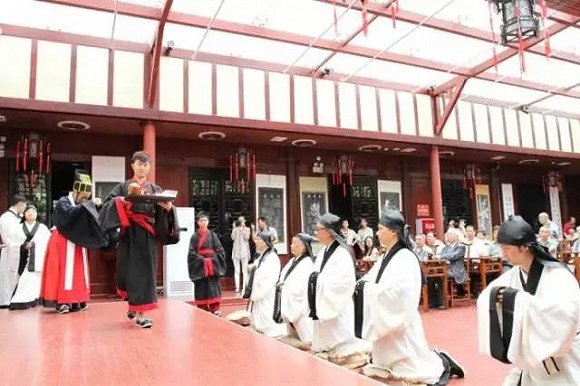
In 2014, the apprenticeship ceremony of Dujiangyan Chinese Academy of Sciences.
Zhang Sheng and I are equally opposed to the establishment of nondescript Confucian colleges in universities, but the biggest difference between him and me is that I am not opposed to vigorously promoting the Confucian tradition. On the contrary, I think this is a good thing that is gratifying, and it is also the inner need of modern Chinese people to seek their spiritual home. A nation cannot be lost in the wilderness of the world of faith for a long time.Original.
However, the revival of traditional culture is destined to go through a difficult and long road, and we cannot treat it with a mentality of eagerness for quick success. Universities, in particular, must abide by their responsibilities seriously and not impatiently join the social trend of vulgarizing traditional culture. That would further harm the already fragmented traditional culture.
I don’t want to be a national advisor or strategist, and I can’t give any prescriptions for this. But before I end this article, I would like to encourage readers with a quote from Confucius: "If etiquette is lost, seek refuge in the wild." I feel that the important mission of reviving traditional culture will probably be shouldered more by civil society in the future.
This article is reprinted with permission from the public account "Glacier Think Tank"