
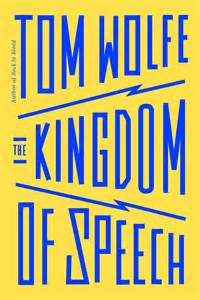
The mysterious linguistic research has recently received "new blood": Tom Wolfe, the famous standard-bearer of the new journalism theory. The 85-year-old Wolff has always been fond of polemics. His new book "The Kingdom of Speech" has provoked two disputes, involving Darwin and Noam Chomsky, the 87-year-old famous linguist and emeritus professor at the Massachusetts Institute of Technology. (New Journalism: a journalism trend that emerged in the 1950s and 1960s, characterized by the bold application of various literary writing techniques to news reports - Translator's Note)
The debate has been going on all summer and shows no signs of abating. Wolfe first considered Darwin's theory of evolution to be "unstructured conjecture—messy, long, smelly, and full of holes" and attacked Chomsky's core theory—Chomsky believed that humans are born with a language organ capable of producing a "universal grammar," which could explain why children can speak very early.
Wolfe attempts to isolate the origin of language from human evolution, and the book eloquently ranges from the Apache cosmology to "body language theory." Wolff calls Chomsky "Noam Charisma" (Charisma refers to the charisma of a leader) and portrays Chomsky as an "armchair professor" who is too lazy to do fieldwork. His personal attack on Chomsky sparked the first major academic controversy of the season.
"Chomsky has the same personality and charisma as the early 19th century French paleontologist Georges Cuvier (known for his "catastrophism"). Cuvier was combative and planned a series of fights, with both good reasons and well-timed, elegant rages. With this On the contrary, Chomsky’s charm had nothing to do with elegance.” Describing Chomsky as a radical in the late 1960s, Wolfe wrote: “He was arrested on a sunny afternoon, and he was released in time and rushed to the Electric, the most famous nightclub in New York. Circus, tells all kinds of war stories."
Chomsky countered. "I didn't know what he was doing," he told the Observer. "It amazes me that his errors and fabrications are so obvious that they are taken seriously. Including his incidental slander about my personal life, any reader can immediately see that they are pure fabrication. And even if they are true, he has no way of knowing."
Wolf's public denunciation of Chomsky stems from his long tradition of satire, as exemplified by his famous ventures in New Journalism writing (such as The Exhilarating Doping Experiment in 1968 and The Right Stuff in 1979) , and the social novel "The Bonfire of the Vanities" published in 1987. In addition, he also dabbled in the fields of modern art and modern architecture, writing "The Painted" Word)" and "From Bauhaus to Our House"
.
However, it may not be that easy to bring down the two giants, Chomsky and Darwin - Wolfe called Darwin a smooth plagiarist and accused him of stealing the ideas of another British naturalist, Alfred Russel Wallace.
Wolf said his interest in evolution stemmed from a lecture he gave in Washington in 2006 on Zola's novel "The Heart of a Beast," which was published in 1888, 29 years after Darwin's "On the Origin of Species."
"Darwin's theory, the more I think about it, the more unreasonable it becomes," Wolfe said. In particular, the evolution of Homo sapiens "has no evidence in some periods." After this doubt, Wolfe also had doubts about the origin of language. In his opinion, the strange gift of language is not the result of human evolution, but a man-made tool.
"My argument is that language is not the result of evolution, but is essentially a word game invented by humans. It's a memory aid that allows humans to store information and then compare it with the latest available information to draw conclusions. "No other species has similar abilities, which is the secret of our racial superiority," Wolff also wrote: "Human physical fitness is actually very pitiful." If you weigh 150 pounds and you're fighting a 150-pound butterfly, you're screwed, and it must be 10 feet tall. But by creating a plan, humans controlled every animal on the planet. Humans are so generous - we even create protected areas for wildlife to survive. However, if they get out of this protective circle, they will be doomed. ”
Wolf then turned his attention to Chomsky. In 1957, at the age of 28, Chomsky published Syntactic Structure (Syntactic Structure).ctures), in which he laid out his theory of linguistics, including the evolutionary way in which language develops.
"Organ, deep structure, universal grammar, device... he explained that the system was physical, empirical, organic and biological," Wolfe said. "He brought the subject indoors and turned it on its head." Even a visiting Martian could "quickly recognize that the language on this planet is the same, with only minor differences in regional accents."
Wolf claims that new discoveries by anthropologist Daniel Everett among the Brazilian tribe "Piraha" prove that language is not a product of evolution but a tool created by humans.
No, Chomsky countered, "The Pirahã learn Portuguese like everyone else, so of course they have the same language faculties, so the basis for the other party's entire argument is gone."
"Nothing new. Everett presented his Pirahã data, which have been carefully studied by linguists (whom Wolfe also cites, without dispute) and have been shown to be wrong. This is also a consistent conclusion reached by experimental cognitive scientists. But it is clear that whatever the facts are, it has no effect on universal grammar, so there is nothing to discuss further."
Wolf is also unlikely to change his stance. "We should first note," he said, "that none of the language organ, universal grammar, language acquisition apparatus... exists in real terms."
Wolf also said he was careful not to confuse Chomsky's theory of language with his radical leftist views. He said: "The reason why he is so famous is that his scientific stance is mixed with his political stance, but I am not considering the political aspect at all here."
Chomsky responded that he knew very little about Wolff and that the two had never had any contact before Wolff asked for an interview. He thinks Wolf misunderstood the debate and that, in fact, there was nothing to argue about.
"The so-called universal grammar, in its modern sense, is a theory about the language faculty (a biological object, similar to the visual faculty), not a special case (just like my visual system is slightly different from yours). Even if someone found that some primitive tribesmen covered one eye with a black blindfold, scientists who study binocular vision would not be interested."
Chomsky added: "Frankly, I'm shocked by the attention this has attracted."
(Translation: Linda)