
At eight o'clock this morning, Beijing time, Professor Stephen Hawking wrote a passage on his Sina Weibo, which is perfectly suitable to be placed at the beginning of this book list.
The Mid-Autumn Festival, this important and ancient cultural festival, is just around the corner. Many cultures around the world have the custom of admiring the moon. Scientists also admire the moon - when our curiosity is attracted by the vast universe, usually the first thing we see in the vast universe is the moon. Therefore, it is probably no accident that Chang'e is both an ancient legend and an exploration project of the China Space Administration.
The moon has been a beacon for mankind since ancient times, illuminating the palace of our thinking and the path of scientific exploration. The moon enriches our stories, inspires our art, and helps us understand Earth's role in the solar system and in the universe. Tonight, when we reunite with our families, admire the moon, recite poems, and look for Chang'e and the Jade Rabbit, we might as well appreciate the meaning of the moon as an individual and as one of the "residents" of the earth.
——SH
"Living with the Moon"
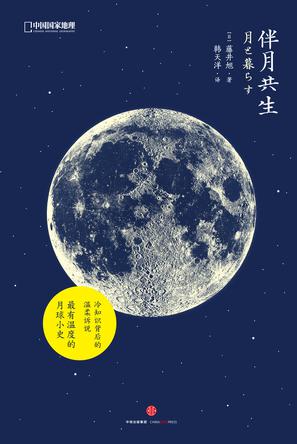
Author: [Japanese] Fujii Asahi
Version: CITIC Press 2016-02
When I was a kid walking at night, I always stared at the moon, wondering what the Chang'e Jade Rabbit was doing. The moon rises brightly, and the moon accompanies people walking around, but it is always there, like lighting a small lamp in the dark night. Now, when I grow up, I have become accustomed to the moon’s companionship and its changing phases every night. As human beings move from the moon to deeper space, we seem to be less curious about the nearest moon. In fact, the moon of each day has its own age and beautiful name, such as the crescent moon, the crescent moon, the first quarter moon, the standing moon, and the standing moon. The moon in different seasons also hides different phenological secrets and emotional connections: Chinese people in the lunar calendar Under the full moon of the Mid-Autumn Festival on the 15th day of the 8th lunar month, there are a series of rituals to pray for reunion and good luck; in Japan, the moon on the 13th day of the 9th lunar month is called "Kuriname Moon", firstly because it is the season when chestnuts are ripe, and secondly because the moon on the 13th day of the lunar calendar is shaped like a chestnut. The moon is not taken for granted, nor is it stationary. The moon also has a different trajectory every night. In the book "Living with the Moon", the author tells us: The moon we observe in the sky at the same place will shift about 12 degrees eastward every day, and the moon's appearance will be delayed by about 50 minutes every day. Of course, this is a "forced" science book about the moon, but it is full of romantic warmth calling us to discover, re-recognize, and fall in love with the moon. Science popularization writer Asahi Fujii's "ghost-written" biography of the moon is full of Eastern culture's unique delicate feelings and yearning for the moon. After reading it, one can't help but look up and gaze tenderly at the bright moon that accompanies you and me. You even want to find the formula at the beginning of the book to calculate the age of the moon tonight.
"Seven Minimalist Physics Lessons"
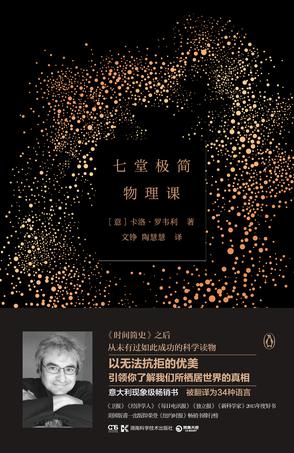
Author: [Italian] Carlo Rovelli
Version: Hunan Science and Technology Press·Boji Tianjuan 2016-05
These seven physics lessons are open to everyone, whether you understand modern science or not, whether you have ever looked into the depths of the stars and thought about the meaning of your and my existence here and now. The total lecture notes for the seven classes are only 90 pages, almost 30,000 words. The author Carlo Rovelli is a theoretical physicist from Italy. He condenses the scientific essence of quantum mechanics, relativity, particle physics, thermodynamics and other fields into seven lessons, unexpectedly and concisely explaining humankind's understanding of physics for centuries. His lectures are concise, clear and full of poetry, as if he is telling a story while taking us into the vast romance of the universe, using beautiful physical theories to constantly refresh our instinctive concepts of time, space, and the creation of heaven and earth. In these seven lessons, we will slowly discover that the curvature of space, the ethics of time, and even all reality are actually far from our inherent cognition. The experience of these seven lessons is like an adventure and a great journey, full of youth, curiosity, poetry and touching. (The last class is high-energy, please bring your own tissues.)
"The Course of the Universe"
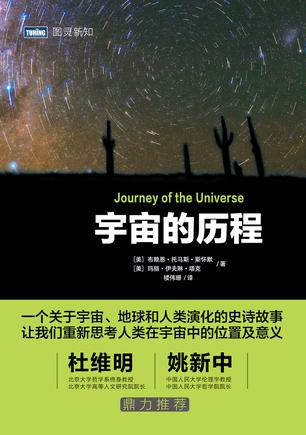
Author: [US] Brian Thomas Swaimer [US] Mary Evelyn Tucker
Version: People's Posts and Telecommunications Publishing House·Turing News 2016-01
What is interesting about this book is that one of the two authors has a Ph.D. in mathematics and the other has a Ph.D. in the history of religions from Columbia University, specializing in East Asian Confucianism. Therefore, Du Weiming, a professor at the Department of Philosophy at Peking University, interpreted it as follows: "This book shows the community formed by the integration of the three talents of heaven, earth and man from the perspective of spiritual humanism." The two authors. With admiration for the creativity of the universe and concern for protecting our homeland, we weave together completely different knowledge to tell an epic story about the evolution of the universe, the earth, and human beings. This story will change our old understanding of matter and time, and reawaken our thinking about human beings' role and mission in the universe. As the first chapter of the book says: "One of the great discoveries of contemporary science is that the universe is not simply a place, but a story - a story in which we are in, belong to and come from. This story can give us a deeper understanding of who we are. Just as one flower and one world, the Milky Way is the universe condensed in the form of galaxies, we are also the universe condensed in the form of human bodies. Every time we look up at the night sky and marvel at the beauty of the universe, it is actually the universe thinking about itself."
"Cosmos: Journey from Earth to the Edge of the Universe"
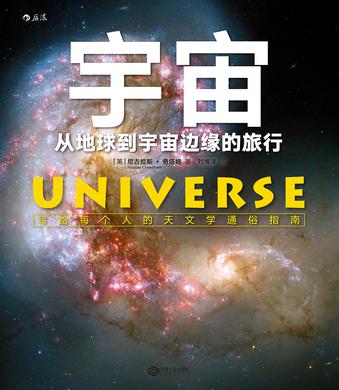
Author: [English] Nicholas Cheatham
Version: Houlang Publishing Company·Jiangxi People's Publishing House 2016-08
This book consists of nearly 200 exquisite images, including near-Earth space images taken by a huge fleet of artificial satellites and interplanetary detectors, as well as magnificent scenes of the deep universe brought to us by the Hubble Space Telescope, the Chandra X-ray Observatory and the Spitzer Space Telescope. Reading this book, it feels like you are transformed into a never-ending photon, flying towards the vast universe. In a few minutes, you will travel through all the neighbors in the solar system, pass through the core of the Milky Way, and then visit our galaxy's neighbors, the Large and Small Magellanic Clouds, experience the evolution, interaction and even merger of galaxies, and listen to the impact echoes reverberating in the depths of the universe. Continuing to advance, we will enter a more strange and vast kingdom, watching galaxy clusters that look like dust on the large-scale cosmic structure. Eventually, we move towards the endless darkness with light and touch the boundary of the visible universe.
"Cosmic User Guide: How to Survive Black Hole Vortexes, Time Paradoxes and Quantum Uncertainty"
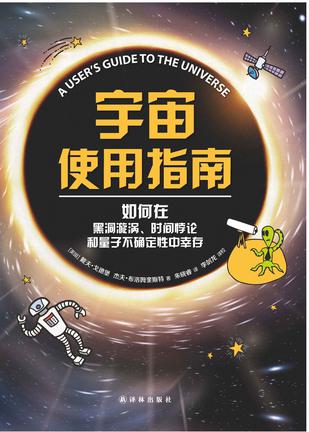
Authors: [US] Dave Goldberg, Jeff Blomquist, etc.
Version: Yilin Publishing House 2016-05
This book is a bold attempt - to successfully introduce modern physics from elementary particles to the Big Bang to ordinary people (or, in other words, a liberal arts student) without using mathematical formulas. A good popular science book on physics should be friendly enough to prevent readers from being overwhelmed by a large number of numbers and terminology, but at the same time, it should be emotional, inspiring and even exciting - this is really not easy (but the above books have done a good job). In addition to the very friendly topics and illustrations, this book also has a Sheldon accent, and the beauty of geek flows between the lines. Questions about whether Schrödinger's cat is dead or alive, whether you can reach the speed of light and still see yourself in the mirror, how to build a time machine, what expectations you can have for changing the past, what happened at the beginning of time, and how high the probability is that we don't exist - these questions that you dare to think about or dare not think about, have thought about or not thought about, asked or kept in your heart are all mentioned in the book. As the saying goes, friends, if you are looking for people to ask questions everywhere, but you cannot find the solution through meditation, and the depression will eventually turn into illness, it is better to read a book.