
Author: Lin Zhang
The rapid growth for two consecutive quarters has made OPPO and vivo become the top five players in the world, approaching the popular Huawei. Under the general trend of slowing down the overall growth rate of the industry, their performance is nothing more than another market disruptor after Xiaomi. While attracting everyone's attention, they also put themselves in the national spotlight.
But an embarrassing reality is: OPPO and vivo are facing a surge in share and an imbalance in brand awareness. Consumers' perception of their brands seems to be polarized between high offline awareness and low online awareness. Another situation caused by cognitive imbalance is that consumers who are accustomed to online manufacturers have a lot of confusion about the current OPPO and vivo: How did these two previously unknown manufacturers suddenly become popular in the eyes of the industry and the media? How did they rise? Why are their products so popular in more than 2,000 markets?
To answer these questions, we first need to understand a question: Why do OPPO and vivo suffer from brand cognitive dissonance?
1. Why do OPPO and vivo experience brand cognitive dissonance?
1. Shifting trend of focus
Attention will always follow hot topics. In fact, before the first half of 2015, the focus of the market, media, and consumers revolved around Internet mobile phone manufacturers or Internet marketing models. The media gave Xiaomi huge exposure; however, OPPO and vivo were ignored by the media because they only regarded the Internet as a channel and did not go all out. The reality caused by this neglect is that during the previous consumption trend cycle, the manufacturers that users came into contact with the most were Xiaomi, Huawei, Meizu, etc., which were playing smoothly in the Internet model.
But starting from the second half of 2015, the market trend began to shift towards offline. At the same time, the attention of the industry and media began to shift offline, allowing OPPO and vivo to gain sudden and huge exposure. Consumers who are accustomed to Internet manufacturers suddenly received a lot of information that they had not paid attention to before. It can be said that many consumers are not ready to receive this change.
2. User growth path
From the perspective of consumer growth path, strictly speaking, the current active netizens all grew up during the explosion of smartphones. As mentioned above, the order of the industry models they have experienced is: Xiaomi - Huawei - OPPO, vivo. Consumers are most familiar with the fan participation marketing, volume model and cost-effectiveness features led by Xiaomi, but are not familiar with the product models of OPPO and vivo.
The superposition of these two factors has resulted in the online consumer market’s incomprehension and cognitive bias towards the offline consumer market.
2. Are OPPO and vivo really rising suddenly as it seems?
After answering the first question, let’s answer what more people are paying attention to and wondering: Why do you feel that OPPO and vivo have suddenly risen?
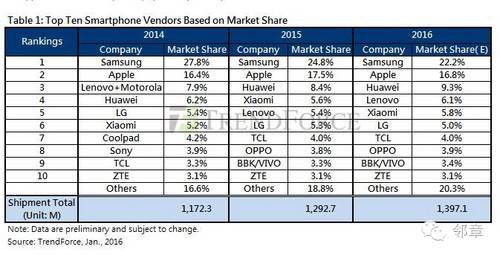
Strictly speaking, OPPO, vivo did not suddenly rise this year, but the growth rate of these two manufacturers has become more vigorous this year. In fact, in 2015, they already had very obvious signs of rise. At that time, in the 2015 annual smartphone shipment statistics report released by TrendForce, the market share of OPPO and vivo showed great growth and entered the top ten in the world (ranking eighth or ninth). However, many media did not pay too much attention to their growth at that time. Instead, they focused on whether Xiaomi's annual shipments could meet the standards and Huawei's annual surge. This year, when the media focused their attention on OPPO and vivo, the high year-on-year growth rates maintained by OPPO and vivo were exposed to an unprecedented scale, which made consumers think that OPPO and vivo suddenly emerged.
3. Why have vivo and OPPO become another industry disruptor after Xiaomi?
There is never unwarranted success or unwarranted failure, so how did vivo and OPPO become among the top five in the world and become another disruptor of the current industry landscape? In fact, if you look back at the path they have taken in the past few years, you can find one or two of them: Vivo and OPPO can become another disruptor in the industry today. This is inseparable from their ability to seize the new industry trend of consumption upgrades, their efforts in the mid-to-high-end market over the years, and their perception of consumer needs.
1. Seize the new trend of consumption upgrade
Previously, Lei Jun proposed the "Flying Pig Theory", emphasizing on following the trend, believing that standing at the forefront of the industry's explosion, pigs can also fly. Although it is ridiculed by many netizens at the moment. But in fact, Lei Jun's "Flying Pig Theory" is very reasonable. Industry trends have a crucial impact on ultimate success or failure. We can see that when the industry was not in the spotlight, many companies launched products that were ahead of their time, but they were not accepted by the public. But when the industry explodes, if you seize the opportunity, you will be able to achieve success more smoothly.
As for the smartphone industry, it has been developing rapidly in the past few years. In fact, if you look closely, there are two major explosions: one is the wave of smartphone popularization, and the other is the ongoing wave of stock replacement and consumption upgrades.
At that time, Xiaomi seized the opportunity of the popularization of smartphones and became a disruptor in the industry. It once left the China Cool Alliance and became the domestic leader. Even though its growth rate is currently slowing down and many people are looking down upon it, the undeniable fact is that Xiaomi still remains in the top five in the domestic market. As a young company, it is considered a miracle to be able to achieve such results.
The rise of Huawei, OPPO, and vivo has captured the smartphone industry’s new trends in stock replacement and consumption upgrading. Three or four years have passed since the popularization of smartphones, and most consumers have also reached a new stage of upgrading their smartphones. The industry characteristics reflected in this new stage are: most consumers' demand for smartphones has evolved from satisfying basic functions and focusing on cost performance to pursuing new realms such as user experience, brand recognition, product workmanship, identity, and taste. The smartphone market has begun to move towards the mid-to-high-end market.
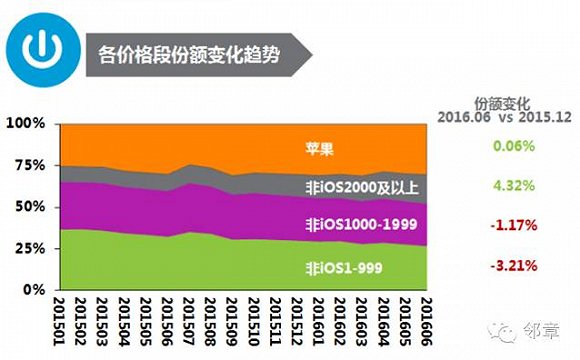
Judging from the current smartphone industry data, it is also very consistent with the trend of consumption upgrading. One is the increase in the overall average price of the domestic smartphone industry, and the other is the further growth of the domestic mid-to-high-end market with prices above 2,000. Data from third parties show that the average selling price of smartphones in China has risen from 1,380 yuan in 2013 to 1,714 yuan in the first quarter of this year; and according to GfK national retail monitoring data, in the first half of 2016, in the Chinese mobile phone market, the price range of 2,500 yuan to 3,000 yuan increased by 111%, and the price range of 3,000 yuan to 4,000 yuan increased by 70%. Data from the Nielsen smart device share monitoring platform also shows that in the first half of 2016, the overall share of mid-to-high-end smartphones (models priced above 2,000 yuan) reached 47.59%, a year-on-year increase of nearly 4.38%. China’s consumption upgrade trend has further boosted consumer demand for mid-to-high-end mobile phones.
2. The rewards of years of hard work in the mid- to high-end market
Practically speaking, OPPO and vivo have always been "unsociable" manufacturers. When the industry was keen on the Internet model, they were relatively silent and still worked in the offline market; when domestic manufacturers liked to use cost-effectiveness to attract consumers, they still maintained the price of their products at 2,000+. Through your own steady and steady progress, you will advance step by step. In this process, OPPO and vivo have also quietly completed the transformation of their brands into mid-to-high-end brands, cultivating the loyalty of their target user groups. At a time when major manufacturers are raising prices for their products and moving towards the mid- to high-end market, OPPO and vivo’s previous market efforts have created a relative first-mover advantage. While some manufacturers have to explain carefully to consumers who are spoiled by cost-effectiveness why their products have to increase in price, the user groups of OPPO and vivo have already accepted the products.
3. Perceive consumer demand
There is no doubt that being able to seize the trend relies on market sense, cultivating user loyalty, and creating tens of millions of shipments. It relies not only on advertising and marketing, but also on having excellent products that meet user needs and meet user needs.
In fact, the products launched by OPPO and vivo are in line with the expectations of their target user groups for their products: integrating all-metal body materials that conform to industry trends, large screens, and industry-leading large running memory, flash charging, HiFi, and selfie technology into one product, it can be said that they have captured the core needs of the target user group. In terms of quality, these two major manufacturers have their own stringent requirements and implement quality inspection standards that are far higher than the industry. In terms of after-sales service, they have given full play to the advantages of offline channels and relieved users of their worries about after-sales service. Because of this, the new products of vivo and OPPO can be recognized by consumers in the market.
4. Is low allocation and high price established?
There is also an interesting phenomenon at the moment: when OPPO and vivo are popular offline, some online users who mainly rely on benchmark scores to make product decisions are dissatisfied with the processors used by OPPO and vivo in their products, thinking that they lack sincerity and jokingly calling them low configuration and high price. So whether the low configuration and high price of vivo and OPPO judged by netizens are enough?Where to stand?
It is true that OPPO and vivo have maintained restraint in the selection of processors in their products and have not made too many efforts. But in reality, high configuration does not equate to high experience. The experience is more a test of the manufacturer's post-optimization and tuning capabilities. Parameter scores are often just a means to show the sincerity of numbers and cannot reflect the true strength of a product. On the contrary, compared with the short-term hormonal stimulation of consumers caused by the accumulation of crude configurations, innovations that meet core needs and solve real pain points are more likely to win the lasting favor of consumers.
Even from the perspective of cost, what really accounts for the bulk of the cost is the screen, memory, and appearance structural parts. According to @Mr, the editor-in-chief of Aifu Technology, "No matter whether it is mid-range, high-end or low-end, the most expensive component in a mobile phone is no longer the processor, but the screen, memory, and exterior structural parts. In these aspects, OPPO and vivo products are definitely higher than the average compared with products in the same price range."
Write at the end:
The rapid growth in market share has made OPPO and vivo the focus of national attention. However, their long-term product strategy of focusing on offline and neglecting online has also caused them to encounter the dilemma of brand cognitive dissonance when facing online consumers. Faced with the dilemma, the two major manufacturers seem to have failed to show sufficient responses. Personally, I believe that vivo and OPPO need to increase their online efforts, build online brand awareness, and create a balanced brand awareness.
The author is Lin Zhang, WeChat ID: ZLxgic, WeChat public account: kejilinzhang