
Suppose you manage a large enterprise that is one of the best in the industry. One day, a new product or service suddenly appears that threatens your survival. This new business model or product will trigger market dislocation competition.
At this time, as an incumbent company, you have to face such a challenging question: Should you imitate what new companies are doing, or double down on existing products and services?
First, you need to analyze competitive threats
The key to understanding the competitive threats of new companies is to analyze the innovative ways they are disrupting the market.
As shown in the figure below, in the curve corresponding to product/service price and function, the blue curve represents the incumbent company. It can provide a large number of differentiated products and services corresponding to price and function and make profits, but it cannot provide all possible products and services, that is, it cannot occupy the entire curve. The red curve determined by technical capabilities represents new start-ups with new technologies. New start-ups first enter the market through a certain point on their curve, and then attract consumers and expand the market through various integrations of price and functionality.
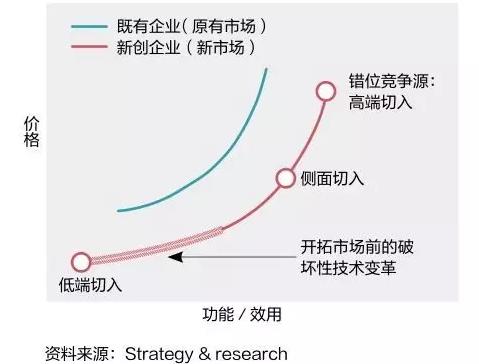
The challenge facing incumbent companies is to find a breakthrough for new start-ups to seize the market: is the low-end market with lower prices and fewer functions being ignored, or is consumer demand not being met and being breached, or is the top-end product and service insufficient to meet the needs of the high-end market and being squeezed? Or are new startups offering more features for the same price?
No matter where you break into the market first, misaligned competition is not simply an extension to the existing market, but a new positioning in terms of price and functionality. New entrants will continue to develop competitive capabilities in a variety of ways. As technology develops, products with better functions will continue to appear. Consumers also generally flock to products that they believe have greater value (utility).
Ultimately, social factors may prompt some adjustments to the new product or service. These factors may stem from legal and regulatory considerations or cultural influences, but new ventures will ultimately be seen as promoters of things like improving the environment or improving living standards. As an incumbent company, it needs to adopt strategies that can optimize functions and reduce prices to deal with the competitive threats posed by new companies.
Next, there are four strategies to choose from
Strategy 1: Face the Threat
The strategy to face threats is to improve existing products and services, retain existing consumers, and continue to expand market share. This is the most effective way to respond when faced with misaligned competitive threats coming from all directions. Of course, incumbents are often reluctant to launch lower-performance, cheaper products to compete with new entrants that have not yet captured their main consumer base. However, the strategy can work from the bottom up.
Existing companies need to develop a product or service line that is completely different from their core product line, and create independent departments to compete with the core product department. When misaligned competition begins in the mid-range or higher-end markets, existing companies must enhance their core product lines to remain competitive.
For example, the automobile industry facing misaligned competition from electric vehicles is exactly such an industry.
In 2016, when Tesla began taking orders for the $35,000 Model 3,Order volume exceeded 325,000 vehicles in the first week, with the total order value approaching US$14 billion. Tesla’s market value is now approaching that of General Motors. But Tesla is by no means alone in this battlefield. Traditional car manufacturers such as Nissan, Honda, Kia, Fiat, Chevrolet, and BMW are all striving to capture the electric vehicle market, and their prices range from high to low.
Strategy 2: Absorb threats
In the face of misaligned competition, an effective way to deal with it is to pull new companies into your own camp - directly control new companies through mergers and acquisitions or venture capital. The absorption strategy can be used to deal with attacks from any direction, but it requires a very high level: post-merger integration capabilities, cooperation capabilities, and keen venture capital capabilities.
When facilitating mergers and acquisitions, existing companies must champion the new business and pave the way for its successful growth. Acquiring a startup simply to eliminate a threat is a waste of time and money and will lead to the emergence of more startups.
Facebook is a case of flexible acquisitions and effective absorption of threats.
In 2014, Facebook spent $19 billion to acquire the chat application WhatsApp. At that time, WhatsApp users had reached more than 400 million, including Generation Z consumers who were born in the digital age and preferred instant chat rather than posting on sites like Facebook. Facebook's move has lived up to its expectations. Today, its stock price has doubled, and WhatsApp users have continued to grow steadily since the acquisition agreement was signed.
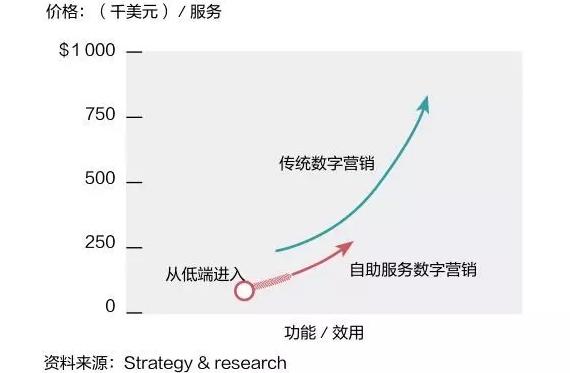
The application of absorption strategies in the digital marketing industry is shown in the figure below. In this industry, disruptive companies continue to emerge, and most of them start from low-end misaligned competition. New start-ups rely on data analysis software to provide potential consumers with various application functions and push the most practical services to them at the right time and through the best channels. This has completely changed the cost and quality of marketing, causing thousands of new startups to engage in an extremely complex misalignment competition.
Strategy 3: Surpass Threats
Overcoming threats is to expand your product and service scope, maintain your core business while providing better products and services than new competitors, and quickly surpass competing companies at a lower cost. Incumbents need to develop capabilities that can sustain their new advantages, as new business is likely to become a major source of revenue.
The span strategy is most effective against mid- to high-end threats. It is difficult for incumbent companies to leapfrog disruptive companies with lower value propositions targeting consumers with the lowest profits. But the reason why consumers leave you is because your products and services lack certain features. If you have such special products and services, you may also attract them back.
For example, the competition between Airbnb, a home-sharing service, and traditional hotels is just such an example. Home-sharing services are often viewed as disruptive services with low-end origins. But to be more precise, this misaligned competition stems from side cuts and is extremely competitive in all price ranges. Data provided by Priceonomics shows that Airbnb isAmong the 10 most expensive cities, the average price per night is US$130 to US$185, which is significantly lower than the average hotel price of US$180 to US$245.
Airbnb’s low-cost business model is difficult for traditional hotels to match. Airbnb has few employees, no construction costs, and no need to provide furniture. It is only responsible for collecting agency fees. Customers can use the Airbnb mobile app to select a room price, location, and learn about local features and details about the home owner.
Large hotel chains need to adopt a model that can move beyond shared services businesses and offer more options to their core customer base, such as private rental services. Customers can choose to stay in private residences, but the hotel can provide them with brand services, such as breakfast, gift services, or special frequent guest package services. This combination of old and new, coupled with the constantly updated App, allows consumers to enjoy more choices. This can also achieve some of the cost-effectiveness advantages that shared services companies have.
Strategy 4: Ignore threats
Ignoring the threat strategy does not mean doing nothing, but it means that existing companies do not need to reinvent or improve their own business to deal with the threats posed by new companies. Instead, they should focus more on their core consumers to maximize their market share. This is more efficient way.
When Southwest Airlines, regarded as a disruptive new entrant, entered the market with low-cost flights, some airlines initially decided to compete with it by establishing subsidiaries and launching low-cost flights, but most of them ended in failure. Instead, many established airlines are focusing on improving their existing services to make them more efficient for their core consumers. Today, we see that even as Southwest dominates the low-cost airline market, many full-price airlines have survived and become stronger businesses.
Of course, there will also be cases where outstanding incumbents fail because they ignore new competitors for too long. Such as Kodak in the photography industry, Smith-Corona in the typewriter industry, Nokia and BlackBerry in the mobile device industry.
The secret to ignoring destructive competition is not really ignoring it. Every business needs the right balance of waiting and responding. If the time comes to respond, you need to be fully prepared and adopt the most appropriate strategy. If you can lower costs and increase the perceived functionality of your products and services, you'll leave startups in the dust.
One of the easiest ways to ignore competing new ventures is to create a platform that is cost-prohibitive to switch to. Microsoft, Google and Facebook can ignore many potential threats because they lock consumers into their systems. If they want to change, core users need to change their systems and relearn the new system functions.
Finally, you need to pay attention
Every strategy has its risks, especially when the timing is wrong or the source of the threat is misjudged. But when you understand where the threats are coming from and how they can steal your market share, you can choose the right response strategy to keep your share.
(The author Alexander Kandybin is a US partner of PwC Strategy&.)