
On August 30, a group of us walked into LeTV. I was deeply impressed by LeTV’s passion, transparency, humility and unique business model. It also triggered my thinking about LeTV’s business logic. I hope that my thinking will be helpful in how to learn from LeTV’s wisdom.
LeTV is undoubtedly one of the most dazzling companies in recent years, and the most eye-catching one is LeTV's "open closed-loop ecological strategy." "Platform + content + application + terminal", "vertical closed-loop ecological chain, horizontal expansion of the ecosystem", "defining the future with the future, defining the present with the future", "vertical integration", "ecological anti-" and other concepts are eye-catching.
Currently, LeTV has formed seven sub-ecosystems - Internet technology ecology, content ecology, large screen ecology, mobile phone ecology, sports ecology, automobile ecology and Internet financial ecology.
On the surface, LeTV’s business is complicated, which naturally raises some questions: Is LeTV an opportunist? Can he achieve ultimate success? Did he violate the basic business laws or subvert the original basic business laws?
What is the business logic behind LeTV?
LeTV’s business model diagram
LeTV summarizes its business model as "platform + content + application + terminal", "user-centered, open closed loop, vertical integration, four-layer architecture, three-core driver", as shown below:
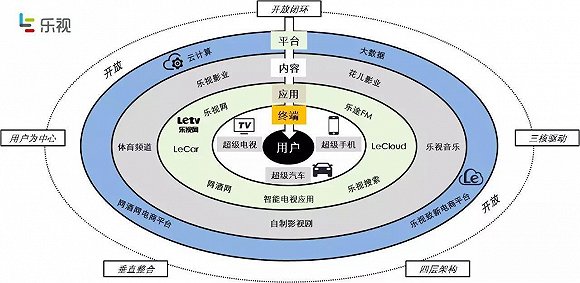
In fact, this picture complicates LeTV and buries LeTV's business logic. Let's look at LeTV's business model from another angle. LeTV's business logic is simple and clear.
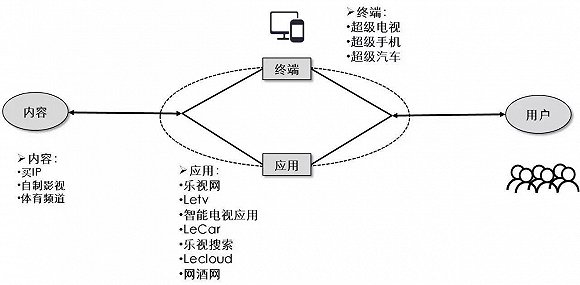
What can we tell from the picture above?
LeTV’s business logic is very simple
1. Sell “content” to users through “promotion channels and distribution channels” such as “terminals” and “applications”
“Content – promotion and distribution channels (terminals and applications) – users” is the main line of LeTV’s business logic.
2. Terminals such as TVs, mobile phones, cars, and LeTV and LeCar applications are actually entrances
The hardware entrance is equivalent to the door of a large yard, and the application is the door of many rooms after entering a yard. The room door of the application can also penetrate across hardware. For example, the LeTV mobile phone can only be the entrance of LeTV, but if the LeTV application is strong and can be applied to other hardware, then other brands of hardwareTransformed into the entrance of LeTV.
3. The entrance is the channel
In the Internet era, the entrance is promotion and distribution channels. Just imagine if LeTV has 100 million mobile phone and TV users and 200 million application users, it will be a powerful promotion and distribution channel! Channels are a key link in operations and a commanding height.
4. Content and terminals can reinforce each other and form a positive feedback loop, which is the key to LeTV’s success
LeTV started with content, and it is content that gives LeTV a broader strategic space in hardware competition with other hardware manufacturers. It can provide free hardware and sell "content-paid memberships", while other hardware manufacturers do not have this kind of synergy.
On the one hand, the existence of content can promote hardware for free and promote the sales of hardware. On the other hand, the expansion of hardware scale brings about the improvement of the power of "promotion channels and distribution channels", which also increases the attraction of content. This is probably the core of LeTV’s “ecological response”.
5. Once each link such as content, mobile phones, and cars has its own advantages, it can form its own sub-ecosystem.
But at the same time, "content - promotion and distribution channels (terminals, applications) - users" should be the unshakable main line for a long time.
6. In addition to "ecological opposition", we must also "define the future with the future"
What is the “biggest future” for LeTV? A core concept is that in the Internet era, all products are connected and interactive Internet terminals. However, some products can bring about greater "ecological reaction". For example, what will be the TV of the future? It may be a home video conference room, it may be a home bank business hall, it may be a home hospital outpatient clinic, or it may be a home video classroom...
I understand that all of LeTV’s innovations are based on “ecological transformation” and “the future definition of all products as connected and interactive Internet terminals”. These are two basic points.
Let’s take a look at LeTV’s development history. With the benefit of hindsight, we can say that LeTV’s ecological strategy seems to be a matter of course.
Key points of LeTV’s ecological strategy
1. The key to LeTV’s success today is that Jia Yueting saw the advent of the era of intellectual property protection when piracy was rampant, so he was able to purchase a large number of film and television copyrights at extremely low prices. This laid the foundation for LeTV’s success and was also the starting point of LeTV’s future strategic trajectory.
2. The marginal cost of content is zero, so expanding content consumption is a core issue. Based on the Internet era and the pain points of TV experience, TV has become a terminal choice that can expand content promotion and distribution channels. At the same time, content can bring strategic space for hardware promotion.
3. Any opportunity is time-sensitive. With knowledge,Without understanding the protection of copyright, subsequent content costs will definitely rise significantly, and the competition for copyright will become more intense. Therefore, self-made content is on the agenda.
4. As content costs rise, there are more urgent requirements for the scale of "terminal entrances" and "application entrances" - to enhance the advantages of "promotion channels and distribution channels".
5. Television, mobile phones, and cars are a person’s most representative terminals. Where does consumers spend their time? In three places, "home - car - office", TV and car are the terminals that occupy a lot of users' time, and mobile phones have become an inseparable connection platform.
The following picture shows the development history of LeTV:
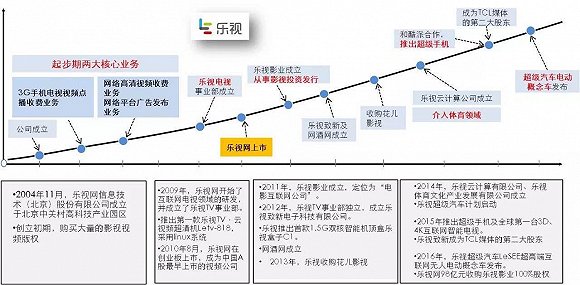 The business logic of LeTV mentioned above is actually the logic of "ecological anti-".
LeTV’s vertical integration and ecological crossover
1. The rationality and importance of vertical integration
In LeTV's ecological strategy, users are the core. Without an active user scale, LeTV's ecological strategy will collapse. To achieve an active user scale, user experience first is the core principle. At the same time, LeTV's products are redefined products. Therefore, vertical integration can be understood as an important means to create redefined products based on user experience first.
2. LeTV seems to have formed the logic of "users - user experience first - user consumption chain"
Users are the core, user experience comes first, and at the same time, it is comprehensively laid out along the user consumption chain to form a moat to protect the user scale (but it should be noted that it is not full integration, but key integration based on the core line of "content + application + terminal").
3. Cross-border and professional
I mentioned in an earlier article on Internet finance that cross-border operations in the Internet era are wrong. In fact, cross-border development and professional operations are the basis for cross-border success. For example, after Alibaba gained advantages in the e-commerce platform, it developed Internet finance across borders. However, the core of Internet finance is still finance, and it is still operated by professional teams. However, there are new operating rules in finance in the Internet era.
Therefore, cross-border ecology is still professional management, but it is just a "new profession" because the product has a new definition, and LeTV's business logic lies in this. For example, mobile phones, cars, etc. are still specialized operations, but in the new era, these products are terminals for interconnection and interaction. Therefore, they are not only products, but also an entrance platform. They are not only independent entrance platforms, but also can serve as entrance platforms for each other. This is the fundamental mechanism for LeTV's internal business to achieve a large number of ecological synergies.
4. Cross-border and border
In fact, LeTV discusses strategy every week. It is not just a matter of new things and strategic innovation, but also a discussion of boundaries. Whether it can produce deep ecology is a core principle of boundaries. But business expansion will bring another challenge, which is the boundary of organizational tension. Of course, I have also seen that LeTV has formed a very distinctive "ecological" organization and management during its development process.
Any success has its own reason. LeTV’s business logic is clear, but LeTV’s future challenges may be that after excessive “subversion and revolution”, it has lost its business logic and lost its “boundaries”. Losing the boundaries will cause rhythm disorder. The biggest challenge brought by rhythm lies in the relative balance between strategic development and organizational capabilities.
All in all, LeTV is an organization well worth studying.
(Recently, Chen Chunhua and Peng Jianfeng of the China Management Model Excellence Award Council investigated the shortlisted company LeTV. The scope of the investigation covered LeTV's strategy, organization, human resources management system, etc. This article is the research result of the author Xia Jingming. Jiemian News deleted the original article when reprinting it.)