Jack Welch has become more and more like an old monster.
He did not reduce his schedule as he got older, nor did he restrain his words and deeds because of the overwhelming criticism. The 81-year-old Welch is still flying around the world: giving speeches, consulting, accepting media interviews, participating in TV debates, coaching troubled CEOs, and guiding young people who are confused in the workplace - he seems to be an omniscient business godfather who always seems to have the truth. By the way, his third wife Suzy Welch (Suzy Welch), who is 24 years his junior, is always with him. The 57-year-old Susie is also energetic, sharp-minded and articulate, and outshines many young girls.
The two men are often controversial when they appear - claiming that CEOs should receive huge salaries, bluntly saying that there are too few women on the board of directors because women delay their work to have children - these are often criticized by well-known bloggers and ordinary netizens.
However, knowing everything and saying something shocking is probably not the key to Welch being disliked. Many people are tired of his face and voice, probably because his era has passed. Although he is truly and truly one of the greatest CEOs of the 20th century, what he represents is the rules and order of the industrial age, the rigid and depressing atmosphere exuded by large companies and assembly lines.
Today’s era is the era of technology geeks, the era of entrepreneurs, and the era where young people can get rich overnight with just a few lines of code. There are more and more stories of software developed casually by American high school students or college students being bought by Silicon Valley giants with huge sums of money. Christia Freeland, the former editor-in-chief of FT US and business writer, has a wonderful summary of this: "If you are very very smart and very very lucky, you can get very very rich very very quikly."
The idols of the younger generation are Steve Jobs, Jack Ma, Zuckerberg and Musk who look down on the world and break the rules. Welch's experience and experience of patiently climbing up and working hard in a giant company from youth to seventy are both stupid and boring in the eyes of today's young people, and no one wants to be him. He was a winner in the golden age of professional managers. The younger generation even lacks interest in Apple, Google, and Facebook. They are eager to create a unicorn with their own hands, or at least join a unicorn company.
So, when I saw Welch publishing a new book "The Nature of Business" at the age of 80, I thought this was just a cliché of a late hero.
There are indeed some clichés in the book: achieving company growth at all costs is the eternal thread in Welch's business philosophy; the five-slide strategy formulation method and the "4E+P" core qualities of outstanding business leaders are basically repetitions of the content in "Win". This book also lacks the buzzwords that populate the business media. Compared with the various business books on the market that are full of new concepts, the concepts and ideas in "The Nature of Business" seem so old and boring at first glance.
If you stop at this book, I can only say that you have missed too much. If you notice what Welch has removed, added, and reiterated in this book compared to previous ones, you will noticeDiscover the true value of this book: This is a guidebook that inherits the basic common sense of management and the unchanging nature of business, while adding new variables in the information age. It is pragmatic, simple, universal, and suitable for almost everyone in the business world, no matter what your current status or situation is.
The Welches obviously did not stay in the last century. They have rich observations and accurate understanding of this new era. Welch has never mentioned the "Six Sigma" he was once so obsessed with; this book also contains almost no terminology or hot words of the Internet era, such as big data, artificial intelligence, VR, sharing economy or the Internet of Things. The Internet has given the entire business world a new coat of paint, and the Welches peel off the surface coating in this book to tell you whether and how the real business world has changed.
Let’s take a look at a few of his insights and suggestions:
" plain. However, do so many anxious traditional businessess owners who are trapped in the quagmire of growth and transformation understand this sentence?
"We must eliminate the monotonous, stupid and oppressive bureaucracy and hierarchy in the company, and do not let employees spend a lot of energy on trivial, heavy, and meaningless work." - Well, this is a message for the boss, but it is a move of conscience for all working people: robots will soon replace humans to do all trivial and uncreative tasks. If your boss is still asking you to do this kind of work, you'd better fire him before he buys the robot back.
"In too many companies, we still see that their organizational charts do not match reality. Risk management managers are left out of important decision-making circles...Similarly, in too many companies, leaders are unwilling to involve the CIO in conversations about corporate strategy. ...If the risk management department and the CIO are marginalized, it can have serious consequences. By the time you realize this, the company may have been hit hard...In other words, in modern society, any company should pay attention to the IT department and risk management department, and recruit excellent people in these areas.talent. It’s hard to imagine a company that doesn’t need such departments. "——Ask any CTO or CRO, and he will tell you that Welch spoke his mind. Ask any CEO, has he ever let the CTO and CRO participate in the company's strategy formulation and decision-making on major matters? Don't regret it when the company suffers a devastating blow due to weak technology and out-of-control risks.
"For many companies in Silicon Valley, catastrophic and sudden "disruptions" are commonplace. There is an acronym for this situation: WFIO (We’re fucked, it’s over). "——WFIO is almost the only new word in Welch's entire book.
“More and more Chinese people dream of becoming entrepreneurs, think like entrepreneurs, and take action. ”——Even Welch felt China’s “mass entrepreneurship and innovation” boom.
“The lack of internationally renowned brands is one of the biggest challenges China will face in the next 10 years. "——It is necessary to mention Welch's prediction ten years ago. In "Win", he said that the Chinese market will become an important force in determining the future business world, and suggested that American business executives should work hard to learn everything about China.
“There was a time when being an entrepreneur wasn’t something everyone wanted to do. Some readers of this book may not remember that era, but it did exist. Back then, groups of people in suits and ties rushed to skyscrapers and other similar buildings in the hope of finding a job, not starting a business. "——Welch mentioned the old days of the 20th century without a nostalgic tone.
"In fact, since 2001, hundreds of people, especially students, have told us excitedly that they aspire to be entrepreneurs, only to hesitate when we then ask, "So what is your unique product or service?" "——Don't wait for investors to ask this embarrassing question, all passionate entrepreneurs should ask themselves first.
“If you want to be an entrepreneur but don’t have a good idea, you might as well join an entrepreneurial team first. Over the past 30 years, countless entrepreneurs have started their careers working for such entrepreneurial technology companies. ”
"In the business world where information technology is rapidly penetrating, there are currently only three themes: 1. How traditional enterprises adapt to changes and gain rebirth; 2. How Internet entrepreneurial enterprises grow up, succeed, and achieve brilliant results; 3. How individuals develop in this switching and wrestling between the old and the new. ”——Welch has his insights and suggestions on these topics.
However, the biggest highlight and the only surprise of this book, in my opinion, is an extremely simple and powerful leadership model proposed by Welch: Truth and Trust——I call it T2 for short. Its full version is:
1. Truth and trust.
2. Continuously explore the truth and build trust relentlessly.
Early when he was CEO of GE, Welch was once asked, "What is your biggest fear as a CEO?" - "My biggest fear is that I am the last person in the company to know the truth." Welch answered.
This classic answer can give us a glimpse into the long roots of Welch's T2 model. From being the CEO of a giant multinational company in the last century, to setting up an online business school after retiring at the beginning of the new century, to traveling around the world for more than ten years, witnessing the difficulties of transformation of traditional enterprises and the rise of Internet startups, Welch finally refined this T2 model that is to the point, simple, easy to implement, and easy to implement: truth and trust. It is probably not an exaggeration to say that this is the wisdom crystallization of Welch's lifelong experience and thinking.
So Welch devoted a whole chapter in the book to explaining the meaning and practice of T2, so there will be no spoilers here. If you are confused or disagree with "T2: Truth and Trust", you may wish to ask yourself two questions before and after reading:
1. Will I tell my boss and subordinates all the information I know and all my thoughts?
2. Will my boss and subordinates tell me all the information they know and all their thoughts?
If yes, congratulations! You are a rare animal in the business world. If not, congratulations! You are the majority in the business world.
The pervasive and lingering sense of anxiety is probably the only thing shared by everyone in this era: large companies are afraid of being subverted by unknown startups; small companies are afraid of not surviving tomorrow; individuals are afraid of being replaced by others or robots.
In an exclusive interview with the editor-in-chief of LinkedIn in 2015, Welch regarded T2 as a tip for both large and small companies: If everyone from the top boss to front-line employees enters the T2 cycle mode, a company can have the muscles of a large company and the soul of a small company at the same time, becoming both strong and agile enough to withstand all kinds of great changes and threats.
To be honest, I highly doubt that Welch’s T2 model has many confidants in China. For the flower of T2 to bloom, it requires integrity and courage from everyone.
In August 2015, I met Mr. Ram Charan, Welch’s close friend and mentor and management guru, in Beijing. At that time, I asked him: "As the greatest CEO of the 20th century, do you think Welch can still be successful in the 21st century?" Mr. Charan replied seriously: "If Welch was 25 years old now and had just started his career, I think he would still become a great CEO." It wasn't until I read "The Nature of Business" half a year later that I believed it: Mr. Charan was right.
As for why Welch can be equally successful in the 21st century? ——The answer is hidden in the book.
(The author Cheng Mingxia is a senior executive at Tencent Research Instituteresearcher. )
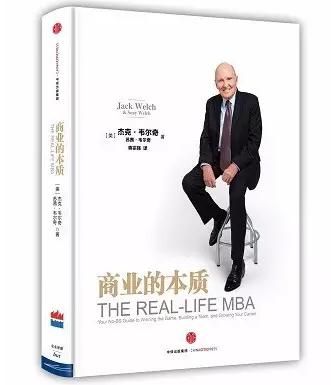
Book title: "The Nature of Business"
Author: [US] Jack Welch, [US] Susie Welch
Translator: Jiang Zongqiang
Published by: CITIC Press
Published: March 2016